


Powered by Trust.Reviews
Insolvency, Trust & Tax Dispute Lawyers Sydney | Finance Litigation NSW
CREDITOR RIGHTS, RESTRUCTURING AND TRUST LITIGATION

Insolvency Asset & Trust Disputes

A plain-English guide to oppression claims, breaches of directors’ duties, company deadlock, and how share buy-outs and winding-up work in Australia.

Understanding insolvency and trust disputes

Your Guide

A company is insolvent when it cannot pay debts as and when they fall due. Formal processes include voluntary administration, liquidation, restructuring and receivership, while personal insolvency is governed by bankruptcy law. Each process has strict gateways, priority rules and review rights.

Trust and asset disputes can involve the validity and administration of a trust, trustee duties, access to information, distributions, removal of trustees and claims that trust property should be available to creditors. The facts, governing instrument and statutory context must be analysed together.

Jaswinder Says

In insolvency work, timing and evidence determine leverage: a missed deadline or untested assumption can change the entire recovery position.

— Jaswinder (Jas) Sekhon · Director / Principal

How the Process Unfolds

FROM DEFAULT TO REVIEW AND DISTRIBUTION

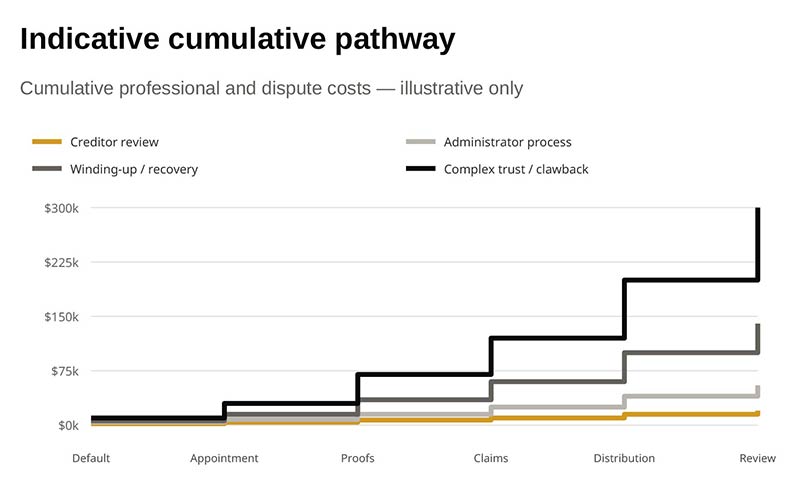
Insolvency disputes usually begin with default, a demand, an appointment or a disagreement about control of assets or trust property. The appointment of an administrator, liquidator, receiver or trustee changes who controls the process and how claims must be advanced. Creditors often need to lodge proofs, preserve security rights and respond quickly to reports, meetings and proposed distributions.

Clawback, priority and trust claims may require detailed tracing, expert accounting evidence and court directions or substantive proceedings. The pathway below is a high-level guide and must be adapted to the
appointment, asset position, security structure and limitation periods.

Indicative Insolvency And Trust Dispute Cost Meter

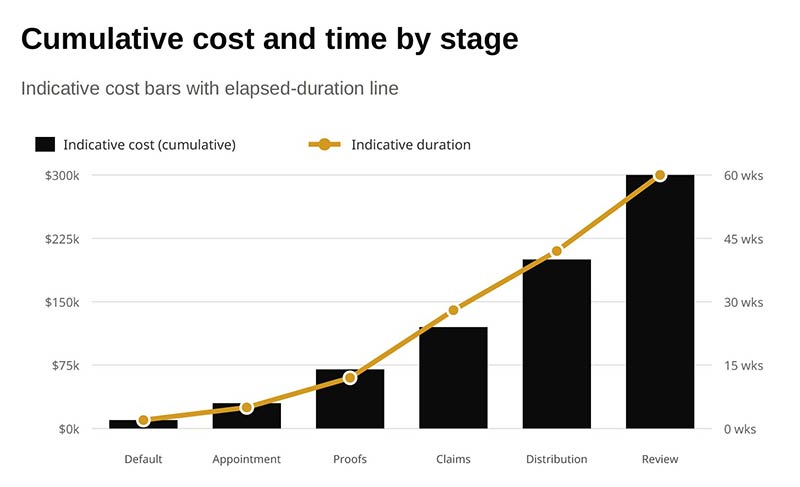
INDICATIVE CUMULATIVE COSTS AND TIME

The cost profile depends on whether the issue is confined to creditor review, requires an administrator’s determination, proceeds to winding-up or involves complex trust and clawback litigation. Forensic accounting, document reconstruction, multiple entities and disputed beneficial ownership can materially increase the work required.

The charts are illustrative and do not replace a written scope or estimate for the particular appointment and recovery strategy. A disciplined merits and recoverability assessment should be completed
before significant litigation expenditure is committed.

Recovery strategy should be tested against asset availability, security, priority, limitation periods, the administrator’s evidence and the likely net return after legal, expert and insolvency-administration costs.

All figures are indicative planning ranges only, exclude GST and disbursements unless stated, and must be verified in a written estimate for the specific matter.

Videos, Guides and Articles

INSIGHTS AND PRACTICAL GUIDANCE

Use these resources to understand the procedure, prepare more effectively and identify the questions that should be addressed before the next stage.
The titles and summaries below are editable placeholders for the final published video and article links.

VIDEOS & GUIDES

Voluntary administration, liquidation and receivership

Who controls the company, what happens to claims and how creditor rights differ.

Voluntary administration, liquidation and receivership

Who controls the company, what happens to claims and how creditor rights differ.

MORE ARTICLES BY JASWINDER (JAS) SEKHON

Test recovery, priority and control before value disappears.

Key terms defined

Loream Ipsum

Oppressionconduct of a company’s affairs that is unfairly prejudicial to one or more members.

Deadlocka stalemate  usually between 50/50 owners that stops the company being managed.

Derivative actiona claim brought in the company’s own name by a member when the directors will not act.

Buy-out ordera court order that one party purchase another’s shares at a set value.

Winding upthe formal closing of a company, with its assets sold and distributed.

Fiduciary dutythe obligation of a director to act loyally in the company’s interests.

Frequently Asked Questions

COMMON QUESTIONS

Practical answers about the process, deadlines, costs, evidence and likely next steps.
These responses are general information only and should be checked against the facts and applicable jurisdiction.

A company is insolvent when it cannot pay its debts as and when they become due and payable.

Administration explores rescue or a deed arrangement; liquidation winds up the company and distributes assets.

A creditor submits the prescribed proof and supporting evidence to the external administrator for adjudication.

Potentially, if the transaction is voidable under the statutory tests and the available defences do not apply.

Priority depends on security, statutory employee priorities, costs of administration and the applicable distribution rules.

A court may remove and replace a trustee where the trust’s proper administration requires it.

That depends on ownership, trust terms, trustee indemnity rights and whether the structure or transactions are successfully challenged.

Yes, wholly or partly, but the creditor may have review rights within a strict timeframe.

Directors may face liability if a company incurs debts while insolvent and the statutory elements are established.

Many are. Proof reviews, set-aside applications, voidable transaction claims and appeals all require prompt attention.Directors may face liability if a company incurs debts while insolvent and the statutory elements are established.

Book your legal strategy information meeting now with a senior lawyer

Fill in the form below to book a 30-minute no-obligation consulting session. 

I will reply within 24 hours.