




LITIGATION COSTS AND COURT CHOICE
Court costs and court limits. Which court do I use?
Understand the likely spend, the right forum, recoverable costs and the decisions that can control your litigation budget.
- Experienced senior lawyers
- Clear pricing guidance
- National practice
UNDERSTANDING COURT COSTS AND JURISDICTIONAL LIMITS
YOUR GUIDE
In NSW, which court hears your claim and what it costs depends mainly on the amount in dispute: smaller claims are heard in the Local Court or NCAT, midrange claims in the District Court, and the largest or most complex in the Supreme Court of NSW.
Goldman Lawyers provides a clear winning litigation strategy, guidance, transparent estimates and strategic advice throughout the life of a matter, including filing fees, professional costs, expert evidence, mediation, hearing preparation, costs orders and recovery.
Jaswinder Says
Early planning, disciplined evidence
and a commercially realistic strategy
are the best ways to manage litigation
cost and greatly improve the outcome's.
— Jaswinder (Jas) Sekhon · Director / Principal
How the Court Process Unfolds
THE JOURNEY OF A TYPICAL NSW LITIGATION MATTER
Most disputes move through a recognisable sequence, although the exact route depends on the court, claim value and urgency. Timing and expenditure can change materially when evidence is extensive, expert witnesses are required or interim applications are sought.
The six stages below show the usual progression from early advice and filing through case management, mediation and hearing. Some matters settle at an early stage; others require multiple applications, substantial preparation or post-judgment costs work. Use this pathway as a planning guide and review the time and cost range against the facts, forum and strategy of your matter.
Pre-action costs
Advice, demand letters, evidence preservation and early negotiation to define the dispute and test settlement options.

Filing & commencement
Select the correct court or tribunal, prepare the originating process, file it and complete valid service.

Interlocutory steps
Pleadings, discovery, subpoenas, expert work, directions hearings and interim applications shape the case before trial.

Mediation
A structured settlement conference tests risk, evidence and commercial options before the cost of final preparation is incurred.
Hearing
Final preparation, witness and expert evidence, written submissions and advocacy before the court or tribunal.
Decision/Appeal/Costs assessment
Recoverable costs are quantified after the substantive dispute, with objections, assessment and enforcement where required.
Indicative & Cumulative Cost Meter
INDICATIVE CUMULATIVE COSTS AND TIME
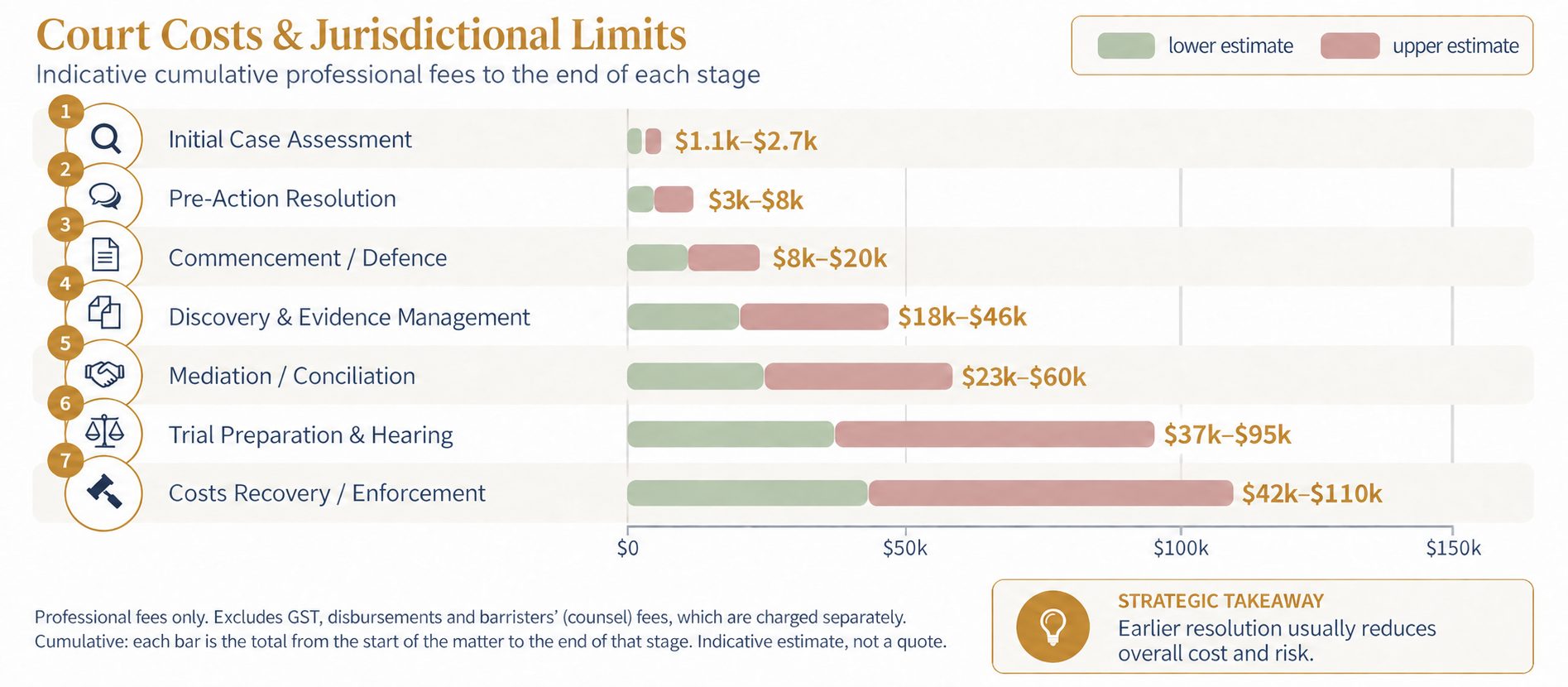
The diagrams compare how cumulative expenditure may build across NCAT, the Local Court, the District Court and the NSW Supreme Court. They also show how elapsed time can rise as the matter moves from pre-action work to filing, interlocutory steps, mediation, hearing and costs assessment.
The ranges are illustrative only: urgent injunctions, expert evidence, multiple parties, appeals and lengthy hearings can materially increase both time and spend. A staged budget, regular review points and a realistic settlement strategy are essential to keeping proportionality and commercial value in focus. You also need to factor in the costs of counsel (barristers).
Actual costs should be assessed against the jurisdiction, experience and costs of counsel, the conduct of the parties, the number of witnesses, the volume of evidence and the commercial value of the outcome. Early advice and disciplined case management can reduce unnecessary steps and improve settlement leverage.
Indicative planning ranges only. Figures exclude GST and disbursements unless stated and must be confirmed in a matter-specific written estimate.
Videos, Guides and Articles
INSIGHTS AND PRACTICAL GUIDANCE
Use these resources to understand the procedure, prepare more effectively and identify the questions that should be addressed before the next stage.
VIDEOS & GUIDES
Voluntary administration, liquidation and receivership
Who controls the company, what happens to claims and how creditor rights differ.
Voluntary administration, liquidation and receivership
Who controls the company, what happens to claims and how creditor rights differ.
ARTICLES

ASSET PROTECTION MOVES INTO THE MARRIAGE? GAMBLING & WASTEFUL SPOUSES.
1. What is the issue?
The issue is whether “addbacks” — assets wasted, spent, or hidden by one spouse —

Court Intervention Held Necessary For General Dysphoria-Related Medical
Keywords: Family Law – Medical Procedures –

Full Court of Family Court Finds No Child Support Resulting Trust Favouring the
What is the Issue?
The case of Bass & Bass and Anor [2016] FamCAFC 64 (29 April 2016) was heard

Get clarity and transparency on costs before you start
- Tailored advice for your forum and dispute
- Transparent staged cost planning
- National litigation experience with Sydney leadership
Key terms defined
GLOSSARY - COURT COSTS & JURISDICTION TERMS
Jurisdictional limitthe maximum amount a court can award; claims above it belong in a higher court.
Costs follow
the event the usual rule that the unsuccessful party pays part of the winner’s costs.
Ordinary (party-
and-party) vs
indemnity coststhe standard partial recovery basis vs the higher basis ordered for unreasonable conduct or after certain offers.
Offer of compromise
/ Calderbank offerformal settlement offers that can shift costs to the indemnity basis if unreasonably refused
Security for costsmoney or a guarantee a plaintiff may be ordered to provide for the defendant’s costs.
Disbursementsout-of-pocket expenses such as filing fees, counsel and expert fees.
Frequently Asked Questions
COMMON QUESTIONS
Legal costs are the first question most people ask and the last one most websites answer clearly. Below are straight answers on who pays, how much you get back, and what you can do to control the risk.
Usually the losing side pays part of the winning side’s legal costs. This is called a costs order. It is not automatic — the judge has a discretion, and the outcome depends on the court, the result, and how each party behaved during the case. You will almost never recover everything you paid your own lawyers.
No. “Costs follow the event” is the starting point, not a rule. A judge can order something different if you won on only some issues, rejected a reasonable settlement offer, ran the case unreasonably, or missed court deadlines. The court can also order each side to bear its own costs.
Yes, often substantially. The most expensive parts of litigation are preparing evidence and running the hearing. Mediating before that work is done can end the dispute outright, or narrow the issues so the hearing is shorter and cheaper for everyone.
Usually not. On a standard costs order (the “ordinary” or “party and party” basis) you typically recover well under what you actually paid — often somewhere between half and two thirds. Fuller recovery only comes with an indemnity costs order, which is exceptional.
In one of three ways: the parties agree a figure; the costs are calculated under a court scale; or a costs assessor reviews the bill and decides what was reasonably incurred and reasonable in amount. Which applies depends on the court and the wording of the costs order. Assessment itself takes time and money.
It depends on how much you are claiming and what remedy you want. In NSW the Local Court hears claims up to $100,000 (its Small Claims Division deals with claims up to $20,000), the District Court hears claims up to $1.25 million, and the Supreme Court has no monetary limit. Some claims must go to a specific court or tribunal under legislation.
Party and party (ordinary basis) costs cover what was necessary to run the case, and recovery is partial. Indemnity costs cover everything reasonably incurred and give the winner a much higher recovery. Courts order indemnity costs in limited situations — for example where a party rejected a reasonable offer or ran a hopeless case.
Whatever the settlement agreement says. Costs are part of the negotiation, and the terms should state clearly whether one side pays the other’s costs, how much, and by when. If the agreement is silent you may need a further court application or a formal costs assessment — an avoidable expense.
In most cases yes, fees are payable when you file. Courts charge separate fees for filing, hearing days and some applications, and corporations pay higher fees than individuals. Waivers, reductions or postponement may be available for concession card holders or where paying would cause financial hardship.
Yes. A properly drafted offer — such as a formal offer of compromise or a Calderbank letter — puts the other side at risk. If they reject it and end up with a result no better than the offer, the court can order them to pay your costs from the date of the offer, often on the indemnity basis.