



COMPANY DISPUTE RESOLUTION EXPERTS
SHAREHOLDER & DIRECTOR DISPUTES, OPPRESSION, BUY-OUTS & COMPANY CONTROL!
Courts can order a share buy-out, regulate the company’s affairs or wind it up under the oppression remedies in ss 232-233 of the Corporations Act 2001 (Cth).
- Experienced senior lawyers
- Clear pricing guidance
- National practice
Understanding shareholder & director disputes
Your Guide
A shareholder or director dispute is a conflict over the ownership or control of a company typically minority oppression, deadlock or breach of directors’ duties resolved under the Corporations Act 2001 (Cth) in the Supreme Courts or the Federal Court of Australia. Oppression ss 232-233, statutory derivative action ss 236-237, just-and-equitable winding up s 461(1)(k).
Jaswinder Says
The strongest company dispute strategy protects evidence and control while keeping a commercially viable exit or buy-out pathway open.
— Jaswinder (Jas) Sekhon · Director / Principal
HOW THIS DISPUTE PROCESS UNFOLDS
FROM GOVERNANCE BREAKDOWN TO COURT REMEDY
Company disputes often begin with information asymmetry, exclusion from management, disputed transactions or a breakdown between owners. The constitution, shareholder agreement, board minutes, financial records and statutory duties should be reviewed before demands are made.
Urgent interlocutory relief may be required to protect assets, records, voting rights, directorships or a pending transaction. Valuation evidence and a realistic exit structure are often central to settlement, especially where the business remains viable. he six-stage pathway below balances preservation, leverage, negotiation and the court remedies available if agreement cannot be reached.
Review company documents
Analyse the constitution, shareholder agreement, cap table, board records, financials, duties and disputed transactions.

Demand & negotiation
Seek information, propose governance protections, challenge conduct and explore a buy-out or structured exit.

Commence proceedings
File an oppression, duty, access, derivative, injunction or winding-up claim in the appropriate court.
Interlocutory relief
Protect assets, records, board control and transaction status while the substantive dispute is prepared.

Valuation & mediation
Obtain valuation or forensic accounting evidence and negotiate buy-out terms, releases and control transition.

Hearing & orders
The court determines oppression, duties, ownership and remedy, including buy-out, regulation or winding up.
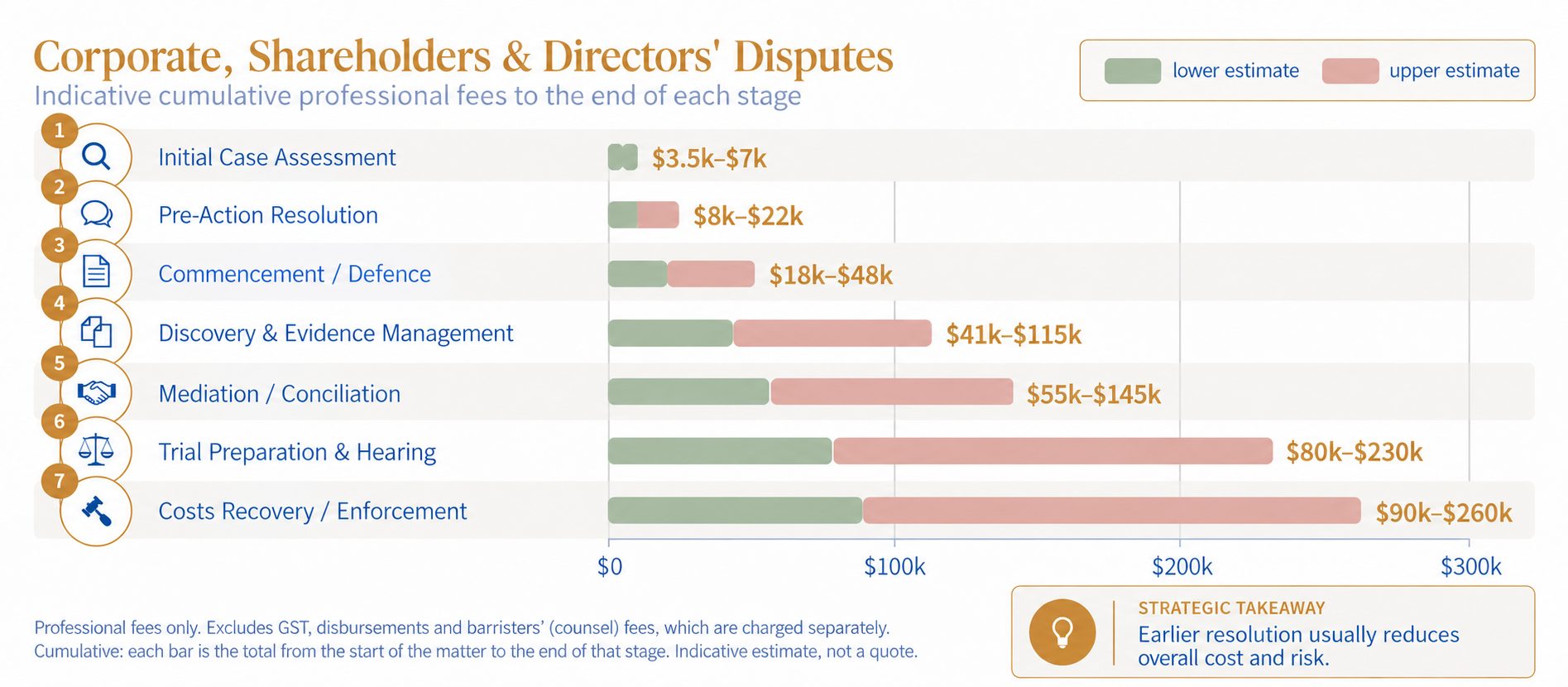
Indicative shareholder dispute cost meter
INDICATIVE CUMULATIVE COSTS AND TIME
The cost pathway depends on whether the dispute resolves through a negotiated exit, mediation and buy-out, oppression proceedings or complex multi-party litigation.
Urgent injunctions, forensic accounting, valuation evidence and contested control of records or assets can rapidly increase expenditure.
The curves are illustrative only and should be replaced by a staged estimate based on the company, remedy and evidence required. Any budget should compare legal cost with enterprise value, cash flow, tax, financing and the practical ability to implement the proposed remedy.
A company-dispute budget should be tested against the likely valuation range, cash availability, taxation, funding and the risk that prolonged conflict erodes the value both sides are trying to protect.
All figures are indicative planning ranges only, exclude GST and disbursements unless stated, and must be verified in a written estimate for the specific matter.
Videos, Guides and Articles
INSIGHTS AND PRACTICAL GUIDANCE
Use these resources to understand the procedure, prepare more effectively and identify the questions that should be addressed before the next stage.
The titles and summaries below are editable placeholders for the final published video and article links.
VIDEOS & GUIDES
Voluntary administration, liquidation and receivership
Who controls the company, what happens to claims and how creditor rights differ.
Voluntary administration, liquidation and receivership
Who controls the company, what happens to claims and how creditor rights differ.
ARTICLES

ASSET PROTECTION MOVES INTO THE MARRIAGE? GAMBLING & WASTEFUL SPOUSES.
1. What is the issue?
The issue is whether “addbacks” — assets wasted, spent, or hidden by one spouse —

Court Intervention Held Necessary For General Dysphoria-Related Medical
Keywords: Family Law, Medical Procedures, Childhood gender

Full Court of Family Court Finds No Child Support Resulting Trust Favouring the
What is the Issue?
The case of Bass & Bass and Anor [2016] FamCAFC 64 (29 April 2016) was heard

Protect business value before the dispute becomes YOUR ONLY business!
- Urgent injunctions and asset/record preservation
- Oppression, buy-out and exit strategy
- Valuation evidence and structured settlement.
Key terms defined
GLOSSARY - SHAREHOLDER & DIRECTOR DISPUTE TERMS
Oppressionconduct of a company’s affairs that is unfairly prejudicial to one or more members.
Deadlocka stalemate, usually between 50/50 owners, that stops the company being managed.
Derivative actiona claim brought in the company’s own name by a member when the directors will not act.
Buy-out ordera court order that one party purchase another’s shares at a set value.
Winding upthe formal closing of a company, with its assets sold and distributed.
Fiduciary dutythe obligation of a director to act loyally in the company’s interests.
Frequently Asked Questions
COMMON QUESTIONS
Disputes between shareholders and directors are rarely only about money — they are about control, information and trust. These answers cover the remedies available under the Corporations Act 2001 (Cth) and what they realistically achieve.
Shareholder oppression is conduct in a company’s affairs that is unfairly prejudicial to, or unfairly discriminatory against, a shareholder. Sections 232 and 233 of the Corporations Act 2001 (Cth) let a court make wide orders to fix it. Common examples are shutting a shareholder out of management, withholding information, stopping dividends while paying excessive director salaries, and diverting business opportunities.
Yes. A buy-out order is the most common remedy in an oppression case under section 233. The court usually orders the majority, or the company itself, to buy the minority’s shares at a value the court sets. It can also order the reverse where the minority’s conduct caused the problem.
Directors must act with care and diligence, in good faith and in the best interests of the company as a whole, for a proper purpose, and must not misuse their position or company information for personal gain. These duties are in sections 180 to 184 of the Corporations Act and are mirrored at general law. Breaches can lead to compensation orders, civil penalties and disqualification.
Start with the shareholders agreement and the constitution. A well-drafted one has a deadlock mechanism, a casting vote, expert determination, or a “shotgun” buy-sell clause. If there is no workable mechanism, the options are mediation, an oppression application, or asking the court to wind the company up on the just and equitable ground.
Directors have a broad right to inspect the company’s books while they hold office. Shareholders have a narrower right, and can apply to the court under section 247A for an inspection order if they are acting in good faith and for a proper purpose. Refusing reasonable access is itself often treated as evidence of oppression.
A derivative action is a case brought on the company’s behalf by someone else, usually a shareholder or director, when the people in control will not sue. You need the court’s permission first under sections 236 and 237 of the Corporations Act. Any money recovered belongs to the company, not to you personally.
The court usually appoints an independent expert valuer. Methods include capitalised earnings, discounted cash flow, or net assets, depending on the business. Two issues drive the result: the valuation date, and whether a minority discount applies, courts often refuse a discount where the buy-out is a remedy for oppression.
Sometimes, but it depends on the company type and its constitution. In a proprietary company removal usually follows the constitution or a shareholders resolution; in a public company shareholders can remove a director by ordinary resolution. Removing a director as a tactic during a dispute can itself be found to be oppressive conduct.
Yes. Under section 461 of the Corporations Act a court can wind up a solvent company where it is just and equitable to do so, for example where there is complete deadlock, the relationship of mutual trust has broken down, or the company’s real purpose can no longer be achieved. It is treated as a remedy of last resort.
There is no fixed rule. Costs usually follow the result, but the court also considers whether the company should bear the costs, whether the applicant’s own conduct contributed to the dispute, and whether reasonable offers were made. In some cases costs are ordered out of the company or adjusted through the share purchase price.