



OUR WINNING LITIGATION STRATEGY
LITIGATION STRATEGY & Working WITH BARRISTERS. COSTS?
Barristers are independent specialist advocates regulated under the LPU Law (NSW/Vic); most counsel are engaged through an instructing solicitor, with direct briefing available only in limited matters.
- Experienced senior lawyers
- Clear pricing guidance
- National practice
WHY A GREAT SOLICITOR & BARRISTER TEAM IS ESSENTIAL IN ANY LITIGATION SUCCESS?
Your Guide
A barrister (counsel) is an independent specialist advocate who advises on and argues cases in court, while the instructing solicitor manages the client, evidence, procedure and budget. The best results come from clearly allocated roles and a brief built around the issues the court must actually decide.
Goldman Lawyers selects counsel according to forum, subject matter, complexity, advocacy style, availability and cost. We then maintain a disciplined flow of instructions, conferences, evidence and written work so the legal team presents one coherent strategy.
Jaswinder Says
Counsel adds the most value when brought in early for a defined strategic purpose, with a disciplined brief, clear instructions and evidence ready to be tested.
— Jaswinder (Jas) Sekhon · Director / Principal
HOW THE BARRISTER/COUNSEL PROCESS WORKS IN A TYPICAL LITIGATION?
FROM CASE THEORY TO COURTROOM EXECUTION
Not every matter requires counsel at the same time, and the decision should be driven by complexity, forum, urgency, value and advocacy need. Early advice from the right barrister can clarify causes of action, evidence, interim relief and settlement leverage before unnecessary work is incurred.
A useful brief is selective, indexed and issue-led rather than a document dump; it tells counsel what advice or advocacy is required and why. The solicitor remains responsible for client communication, procedural management, evidence collection, expert coordination and the overall cost plan. The six stages below show how Goldman Lawyers builds and manages a solicitor–counsel team from initial strategy through hearing and post-hearing review.
Initial Brief & Advice on Prospects
A focused brief, a conference and counsel’s advice on prospects, value and the evidence needed. In NSW a damages claim or defence cannot be run without a reasonable belief in its prospects.
1 to 3 weeks
Interim Issues & Security for Costs
Counsel settles the application, writes submissions and appears on contested interim issues: security for costs (often sought against an overseas or thinly capitalised plaintiff), injunctions and freezing orders, strike-out and discovery disputes.
Urgent: days. Otherwise 3 to 8 weeks for each application
Pleadings
Counsel drafts or settles the statement of claim, defence, cross-claim, reply and particulars. The pleadings fix what must be proved and disclosed, so care here saves cost at every later stage.
2 to 6 weeks for each round
Mediation
Counsel settles the position paper, attends the mediation and advises on offers, Calderbank letters, offers of compromise and the settlement deed. The last realistic off-ramp before a final hearing.
4 to 8 weeks to convene; usually one day

Final Hearing
Advice on evidence, settling affidavits, objections, written opening, cross-examination, the hearing days, closing submissions and any costs argument. The largest counsel cost: each day in court carries 1.5 to 2 days of preparation.
6 to 12 weeks to prepare; 1 to 8 hearing days

Appeals
Advice on appeal prospects, the notice of appeal and grounds, written submissions and the appeal hearing, usually a day or less. Strict time limits apply, commonly 28 days. Reached by few matters.
28 days to file; 6 to 12 months to a hearingHOW MUCH DO BARRISTERS COST ?
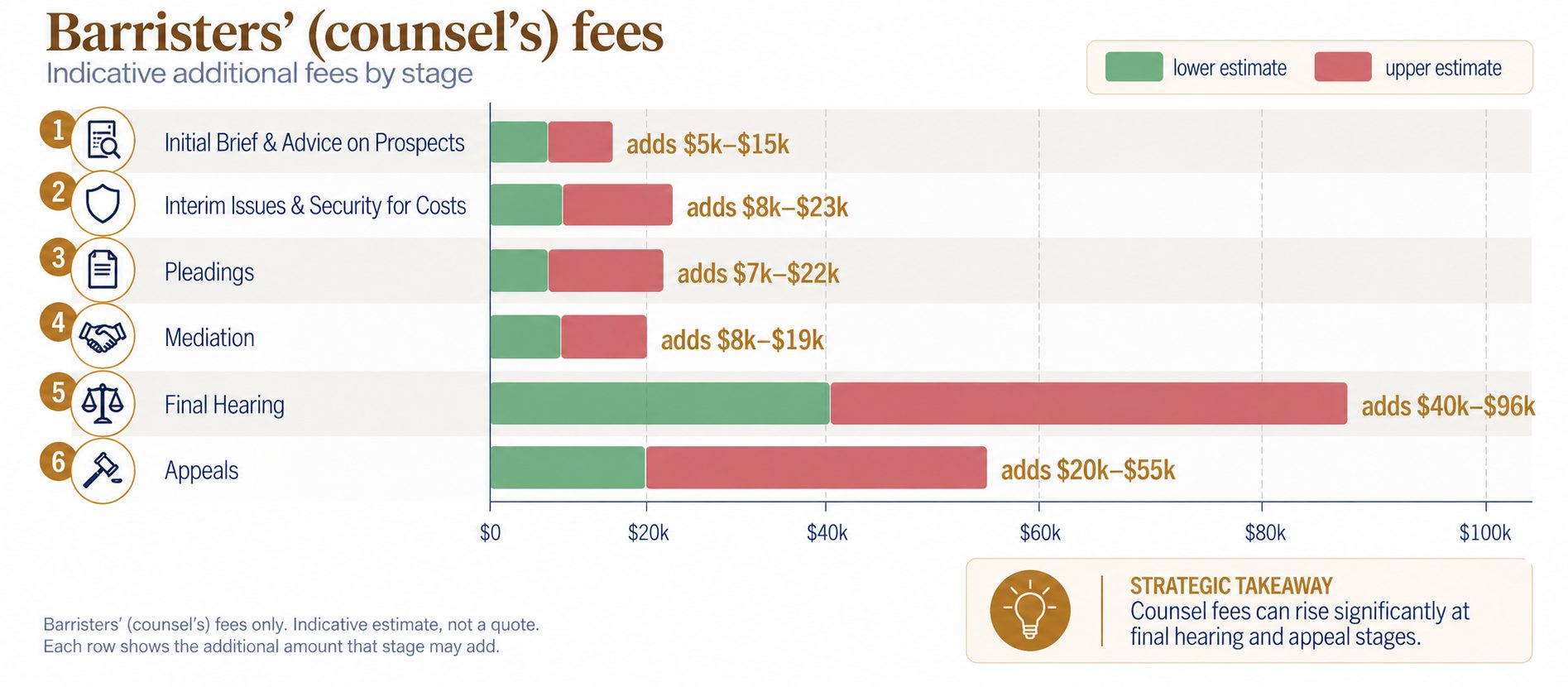
INDICATIVE CUMULATIVE COSTS AND TIME
The cost pathway depends on whether the demand prompts payment, is resolved by negotiation, proceeds to a set-aside application or leads to winding-up litigation. Because the 21-day deadline is strict, legal work is often compressed and urgent evidence may be required from directors, accountants and the creditor.
The charts are illustrative only and do not account for every solvency report, contested debt issue, substitution application or appeal. A creditor should assess the risk of a genuine dispute before issuing, and a company should act immediately rather than using the demand as a negotiation timetable.
| Counsel | Who they are | Hourly, Sydney | Daily, Sydney | Daily, other capitals and regional |
|---|---|---|---|---|
| Reader | First year at the Bar, under tutors (NSW) or a mentor (Victoria). Often an experienced former solicitor. | $180 – $330 | $1,800 – $3,000 | $1,500 – $2,500 |
| Junior counsel | About 2 to 7 years at the Bar. | $330 – $550 | $3,000 – $5,000 | $2,500 – $4,200 |
| Senior junior | About 8 years or more at the Bar. Runs most hearings without a silk. | $550 – $950 | $5,000 – $8,500 | $4,000 – $7,000 |
| Senior Counsel (SC or KC) | “Silk”. Appointed for eminence in advocacy; usually leads a junior. | $1,000 – $2,000 | $9,000 – $18,000 | $7,000 – $14,000 |
| Leading commercial and tax silks | The top of the Sydney and Melbourne Bars. | $2,500 and above | $20,000 – $30,000 and above | Same rate wherever they appear |
| Appearance or task | What counsel charges | Typical cost, Sydney |
|---|---|---|
| Directions hearing or mention | One to two hours at the hourly rate; usually a reader or junior. | $300 – $1,000 |
| Contested interlocutory hearing, two hours to a day | One to three days’ fees, including preparation and written submissions. | $2,500 – $8,000 junior; $8,000 – $23,000 senior junior |
| Mediation | The day, plus half a day to a day of preparation. | $3,700 – $8,000 junior; $8,000 – $19,000 senior junior |
| Written advice on prospects | One to two days. | $5,000 – $15,000 senior junior; $10,000 – $22,500 Senior Counsel |
| Cancellation fee | Senior counsel commonly charge for some or all of the days set aside if a hearing is vacated or settles late. It must be disclosed in advance and be fair and reasonable, and it is rarely recoverable. We settle the terms before we brief. | By agreement |
The substantiation for section 1: counsel-days at each stage multiplied by the daily rate. The workbook carries the same build-up in formulas, so a changed rate or day count flows through every table.
| Counsel-days at each stage | Junior counsel alone | Senior junior alone | Senior Counsel | Junior to Senior Counsel |
|---|---|---|---|---|
| Stage 1 Initial Brief & Advice on Prospects | 0.75 – 1.25 | 1 – 2 | 1 – 1.5 | 1.5 – 3 |
| Stage 2 Interim Issues & Security for Costs | 1 – 2 | 1.5 – 3 | 1.5 – 3 | 2 – 4 |
| Stage 3 Pleadings | 0.75 – 1.5 | 1.5 – 3 | 1 – 2 | 2.5 – 5 |
| Stage 4 Mediation | 1.5 – 2 | 1.5 – 2.5 | 1.5 – 2.5 | 1.5 – 2.5 |
| Stage 5 Final Hearing | 3 – 5.5 | 8 – 13 | 11 – 18 | 14 – 21 |
| Stage 6 Appeals | 3.5 – 6 | 4 – 7 | 4 – 6 | 5 – 8 |
| Daily rate used | $2,500 – $4,000 | $5,000 – $7,500 | $10,000 – $15,000 | $3,500 – $5,000 |
A counsel-day is one day’s fee, however the hours fall. Stage 5 is preparation plus hearing days plus closing submissions. Every published range is about 2.4 to 3.0 times low to high, the same discipline as the 17 September tables. Leading silks at $20,000 a day and above, hearings beyond eight days and further interlocutory applications sit above these ranges.
Videos, Guides and Articles
INSIGHTS AND PRACTICAL GUIDANCE
Use these resources to understand the procedure, prepare more effectively and identify the questions that should be addressed before the next stage.
VIDEOS & GUIDES
Voluntary administration, liquidation and receivership
Who controls the company, what happens to claims and how creditor rights differ.
Voluntary administration, liquidation and receivership
Who controls the company, what happens to claims and how creditor rights differ.
ARTICLES

ASSET PROTECTION MOVES INTO THE MARRIAGE? GAMBLING & WASTEFUL SPOUSES.
1. What is the issue?
The issue is whether “addbacks” — assets wasted, spent, or hidden by one spouse —

Court Intervention Held Necessary For General Dysphoria-Related Medical
Keywords: Family Law, Medical Procedures, Childhood gender

Full Court of Family Court Finds No Child Support Resulting Trust Favouring the
What is the Issue?
The case of Bass & Bass and Anor [2016] FamCAFC 64 (29 April 2016) was heard

DISCUSS OUR BARRISTERS INSERTION STRATEGY BEFORE YOUR LITIGATION!
- Immediate demand and service review
- Set-aside evidence and filing strategy
- Creditor and winding-up representation
Key terms defined
Barrister (counsel) Fees
Barrister (counsel)an independent specialist advocate who advises on and argues cases in court
Briefthe organised instructions, documents and questions the solicitor delivers to counsel
Senior Counsel
/ King’s Counsel
(SC/KC)senior barristers appointed for eminence in advocacy
Direct briefingengaging a barrister without a solicitor, permitted only in limited matters
Conferencea working meeting between counsel, instructing solicitor and client
Advice on evidencecounsel’s written opinion on the evidence needed to prove the case.
Frequently Asked Questions
COMMON QUESTIONS
Knowing when to bring in counsel — and which counsel — is one of the highest-leverage decisions in any dispute. These answers explain how the solicitor and barrister relationship works in Australia and what it costs.
A barrister is a specialist courtroom advocate and independent adviser. Your solicitor runs the case day to day, evidence, correspondence, procedure and strategy, and briefs a barrister to appear in court, draft key documents such as pleadings and submissions, and give independent advice on prospects. In Australia barristers are sole practitioners and are normally briefed through your solicitor.
Earlier than most people expect. The highest-value moments are before proceedings start (advice on prospects and strategy), when the pleadings are drafted, before a mediation, and in the lead-up to the hearing. Bringing counsel in early usually costs less overall than repairing a case that has been pleaded or run the wrong way.
Senior Counsel (SC) or King’s Counsel (KC) are experienced barristers appointed in recognition of eminence, and are briefed in complex, high-value or high-risk matters. Junior counsel handle most day-to-day advocacy and drafting at a lower rate. In substantial cases a silk and a junior are briefed together, with the junior doing the detailed preparation.
No. You can be represented by your solicitor alone, or represent yourself. Whether counsel is worth it depends on the amount at stake, the complexity of the law and evidence, the level of the court, and who is acting on the other side. In appellate and complex commercial matters counsel is close to essential.
Usually under a fee agreement with your solicitor setting out an hourly rate, a daily hearing rate (often called a refresher), and fixed fees for defined work such as an advice or a pleading. Cancellation fees can apply if a hearing is vacated late. You should receive a costs disclosure and an estimate before the work starts.
Yes, in conference, that is the normal way instructions are taken and advice is given, with your solicitor present. Some barristers accept direct access briefs for limited work, but for litigation the solicitor and counsel model remains standard, because someone has to run the file, hold the evidence and manage the court process.
It is a written opinion from counsel on whether your claim or defence is likely to succeed, the realistic range of outcomes, and what it will take to get there. It is the single most useful document for deciding whether to sue, settle or stop, and it can also help protect your position on costs later.
Usually yes, and that continuity is valuable. The barrister who will run the hearing is best placed to explain the real risks at mediation and to draft settlement terms that are enforceable. Where availability or budget is an issue, a junior may cover interlocutory steps with a silk briefed for the trial.
Partly. Counsel’s fees are usually recoverable as a disbursement under a costs order, but only to the extent the court or costs assessor accepts it was reasonable to brief counsel at all, and that the fee was reasonable in amount. Briefing counsel in a small or straightforward matter may not be recoverable.
By matching the barrister to the case, not to the budget. We look at the field they actually practise in, commercial, employment, insolvency, regulatory or family. We check their experience in the particular court or tribunal, and their record against the other side’s counsel. Availability across the hearing window matters, and so does how they perform in a mediation room.