



Powered by Trust.Reviews
Regulatory, Health & Administrative Disputes - Goldman Lawyers
PROFESSIONAL REGULATION, LICENSING & GOVERNMENT REVIEW

PROTECT YOUR PROFSSION & BUSINESS: REGULATORY & LICENSING ACTION REVEIW LAWYERS

Most merits-review applications must be lodged within 28 days of the decision, and AHPRA can take immediate action against a practitioner’s registration before any hearing.

REGULATORY & LICENSING DISPUTES 

Your Guide

Regulatory and administrative disputes are challenges to decisions of regulators such as AHPRA and the National Boards, licensing bodies and government agencies, pursued through internal review, merits review in a tribunal, or judicial review in court.

The key distinction is between merits review, which remakes the decision on the facts and law, and judicial review, which examines legal error. Deadlines, stay applications and the evidentiary record require immediate attention.

Jaswinder Says

A regulatory response should aim to protect the immediate right to practise while building the factual and expert record needed for the final review.

— Jaswinder (Jas) Sekhon · Director / Principal

How the REVIEW Process Unfolds

FROM NOTICE TO REVIEW AND FINAL DETERMINATION

The process commonly begins with a complaint, investigation notice, proposed condition, refusal, suspension or immediate-action decision. Early submissions can influence whether the matter resolves without a formal hearing and what evidence is accepted into the record.

Urgent stay or interim relief may be required to preserve registration, employment, income or business operations pending review. Merits review usually involves fresh consideration of the decision, while judicial review focuses on jurisdiction, procedure and legal error. The stages below provide a practical guide, but the statute, regulator, tribunal and applicable filing deadline must be checked for every matter.

Most important: Say nothing, engage professional lawyers as soon as you become aware of any proposed action by any regulator or licensing body.

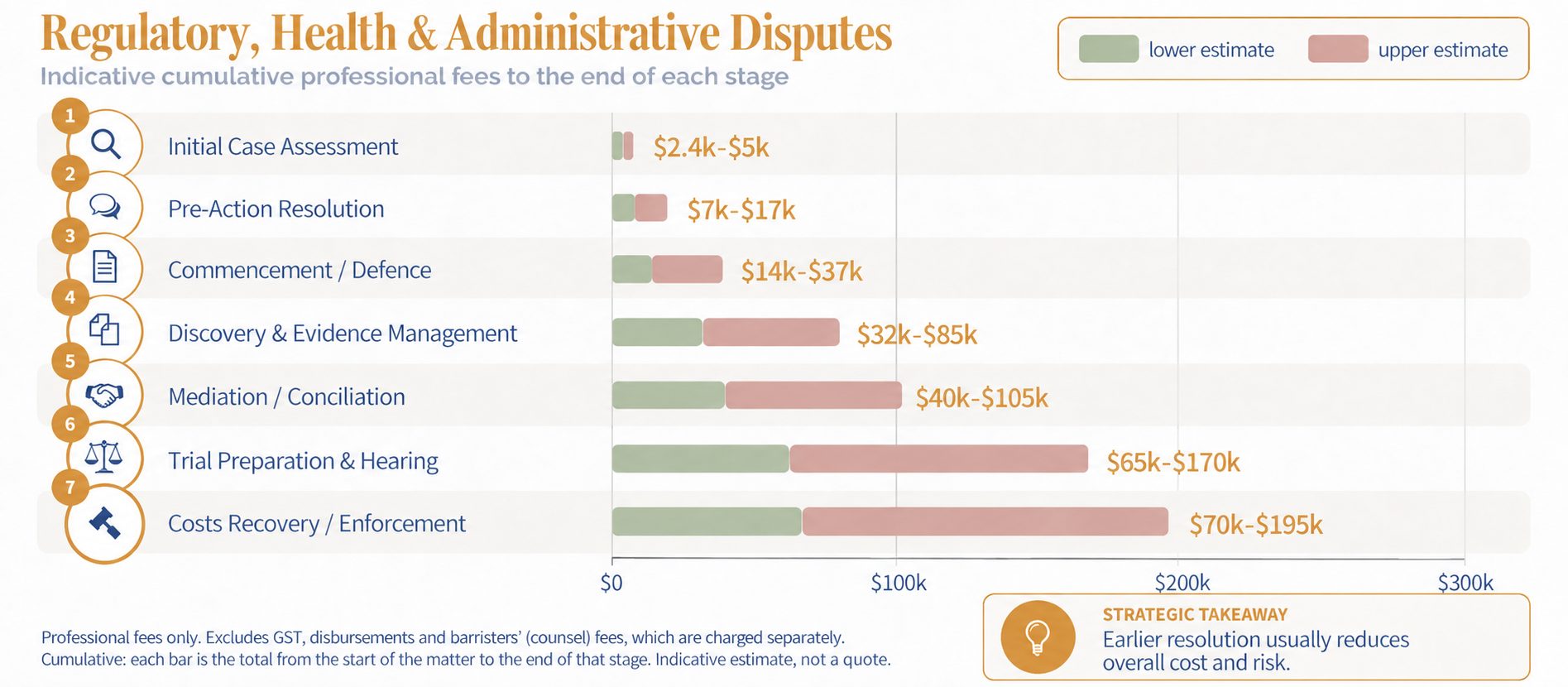
How much does challenging a regulator or licensing body cost?

INDICATIVE CUMULATIVE COSTS AND TIME

The cost pathway differs between early submissions, NCAT merits review, federal Administrative Review Tribunal proceedings and court-based judicial review. Expert reports, urgent stay applications, multiple allegations and parallel employment or criminal issues can increase complexity and urgency.

The figures are indicative planning ranges only and must be checked against the regulator, statutory scheme and scope of evidence. Early strategy should focus on preserving practice rights, controlling the record and matching the legal forum to the actual error or outcome challenged.

Regulatory cost planning should account for the professional and commercial consequences of interim restrictions, the need for expert evidence, parallel proceedings and the value of an early, well-supported resolution.

Indicative planning ranges only. Figures exclude GST and disbursements unless stated and must be confirmed in a matter-specific written estimate.

Videos, Guides and Articles

INSIGHTS AND PRACTICAL GUIDANCE

Use these resources to understand the procedure, prepare more effectively and identify the questions that should be addressed before the next stage.

VIDEOS & GUIDES

Voluntary administration, liquidation and receivership

Who controls the company, what happens to claims and how creditor rights differ.

Voluntary administration, liquidation and receivership

Who controls the company, what happens to claims and how creditor rights differ.

ARTICLES

You must protect your business and profession before action.

Key terms defined

GLOSSARY — REGULATORY & ADMINISTRATIVE LAW TERMS

AHPRA notification a complaint or concern lodged with the regulator about a health practitioner

Immediate action urgent suspension or conditions imposed to protect the public before a full hearing

Show-cause notice a notice requiring written submissions on why proposed action should not be taken

Conditions &
undertakings
restrictions on practice imposed by, or agreed with, the regulator

Merits review a tribunal remaking the decision on the facts and law to reach the correct and preferable outcome

Judicial review a court examining whether the decision was lawfully made (ADJR Act / s 75(v)), not whether it was right.

Frequently Asked Questions

COMMON QUESTIONS

Regulatory decisions move quickly and the review deadlines are short. What you write in your first response usually shapes the entire outcome. These answers cover health practitioner regulation and administrative review generally.

AHPRA and the relevant National Board gather information, assess the risk to the public, and normally invite you to make a written submission. The Board can take no further action, caution you, impose conditions, accept an undertaking, or refer the matter to a tribunal. What you put in that first submission shapes everything that follows.

Yes. NSW is a co-regulatory jurisdiction. Complaints about registered health practitioners in NSW are handled by the Health Care Complaints Commission and the relevant NSW health professional council, supported by the Health Professional Councils Authority — not by AHPRA directly. The process, timeframes and review rights differ, so get NSW-specific advice.

Often yes. But the regulator can take immediate action — suspending your registration or imposing conditions — before any finding is made, if it believes there is a serious risk to the public. If that happens you usually have a short window to seek review or a stay, so respond urgently.

Immediate action is an interim protective step taken before a matter is finally decided — typically suspension, conditions on practice, or accepting an undertaking. It is not a finding of guilt. You are normally given a short opportunity to respond before it takes effect, and the decision can usually be reviewed by a tribunal.

Merits review means a tribunal stands in the shoes of the original decision-maker and decides the matter again — the facts, the law and any discretion — to reach the correct or preferable decision. It can consider new evidence. In NSW this is usually NCAT; at the federal level it is the Administrative Review Tribunal, which replaced the AAT in October 2024.

Judicial review asks whether the decision was made lawfully — was there power to make it, was the correct procedure followed, was there a legal error or a denial of procedural fairness. The court does not decide whether the decision was right. If judicial review succeeds, the decision is usually sent back to be made again.

It depends on the legislation and the type of decision, and some deadlines are as short as 28 days. The decision notice will normally state your review rights and the time limit. Read it the day it arrives — missing the deadline can end your rights entirely.

Sometimes. A stay may be available under the governing statute, but you have to apply for it and satisfy the relevant test — usually an arguable case, the balance of convenience, and the public interest. In health matters, protection of the public weighs heavily against granting a stay.

Often, particularly in health, technical and professional matters. Where the question is whether your conduct met accepted professional standards, evidence from a peer in the same field is usually essential. Expert evidence must be independent and comply with the tribunal’s expert witness code of conduct.

Yes, and often quickly. A condition or suspension on your registration can set off your employer’s own disciplinary process, and many contracts allow termination. You may also have to tell your professional indemnity insurer, other regulators, and employers in other states. Deal with all of that at the same time, not afterwards.

Usually yes, but appeal rights are narrower than review rights and are often limited to questions of law. There is a specific statutory pathway — for example an internal NCAT Appeal Panel and then the Supreme Court — and a strict deadline. Check the appeal route stated in the decision itself.

Goldman Law

CONFIDENTIAL NO OBLIGATION HELP

INQUIRY OR DISCUSSION
WITH A SENIOR LAWYER

BOOK A CALL BACK


Book your legal strategy information meeting now with a senior lawyer

Fill in the form below to book a 30-minute no-obligation consulting session. 

I will reply within 24 hours.