



Powered by Trust.Reviews
Statutory Credit Demands - Goldman Law
STATUTORY DEMANDS — PART 5.4 CORPORATIONS ACT 2001 (CTH)

CREDITOR'S STATUTORY DEMANDS — RESPOND OR SET ASIDE WITHIN 21 DAYS

The statutory minimum debt ($4,000) and a set-aside application under s 459G must be filed AND served within the 21 days, with no extensions.

UNDERSTANDING STATUTORY CREDIT DEMANDS

Your Guide

A creditor’s statutory demand is a prescribed demand under section 459E of the Corporations Act 2001 (Cth) requiring a company to pay, secure or compound an eligible debt within 21 days. It is a powerful insolvency procedure, not merely an ordinary debt-collection letter. If the company neither complies nor files and serves a valid set-aside application within time, a presumption of insolvency can arise and support a winding-up application. The debt, demand, affidavit and service must therefore be checked immediately.

Jaswinder Says

A statutory demand is won or lost in the first days: verify the debt, service, supporting affidavit and available set-aside grounds immediately.

— Jaswinder (Jas) Sekhon · Director / Principal

How the Process Unfolds

FROM SERVICE TO WINDING-UP RISK

The procedure begins when a compliant statutory demand is served on the company at its registered office or by another valid method. The 21-day period runs strictly, and the company cannot rely on informal negotiations while allowing the filing deadline to expire.

A genuine dispute, offsetting claim or defect causing substantial injustice may support a set-aside application if raised properly and in time. Non-compliance creates a presumption of insolvency that a creditor may rely on in a later winding-up application. The stages below show the usual sequence, but urgent legal review is required as soon as the demand is received or before one is issued.

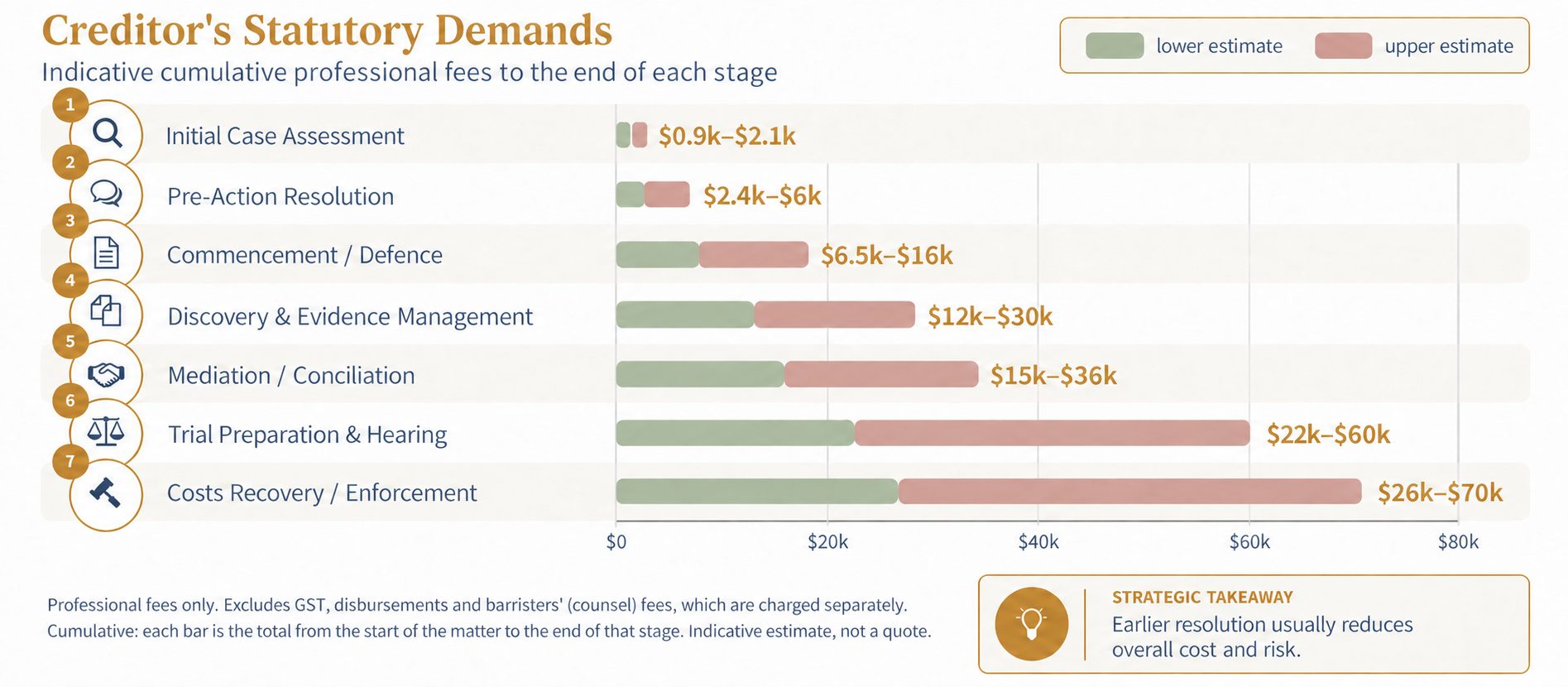
HOW MUCH DOES A STATUTORY DEMAND COST TO SERVE OR SET ASIDE?

INDICATIVE CUMULATIVE COSTS AND TIME

The cost pathway depends on whether the demand prompts payment, is resolved by negotiation, proceeds to a set-aside application or leads to winding-up litigation. Because the 21-day deadline is strict, legal work is often compressed and urgent evidence may be required from directors, accountants and the creditor.

The charts are illustrative only and do not account for every solvency report, contested debt issue, substitution application or appeal. A creditor should assess the risk of a genuine dispute before issuing, and a company should act immediately rather than using the demand as a negotiation timetable.

Statutory demand costs should be compared with the debt, recoverability, solvency evidence, the prospects of a genuine dispute and the commercial consequences of a winding-up application. Excluding counsel costs.

Indicative planning ranges only. Figures exclude GST and disbursements unless stated and must be confirmed in a matter-specific written estimate.

Videos, Guides and Articles

INSIGHTS AND PRACTICAL GUIDANCE

Use these resources to understand the procedure, prepare more effectively and identify the questions that should be addressed before the next stage.

VIDEOS & GUIDES

Voluntary administration, liquidation and receivership

Who controls the company, what happens to claims and how creditor rights differ.

Voluntary administration, liquidation and receivership

Who controls the company, what happens to claims and how creditor rights differ.

MORE ARTICLES BY JASWINDER (JAS) SEKHON

Treat every statutory demand as a 21-day emergency.

Key terms defined

GLOSSARY — STATUTORY DEMAND TERMS

Statutory demand a formal demand under s 459E requiring a company to pay, secure or compound a debt of $4,000 or more within 21 days

Genuine dispute a real, not spurious, dispute about the existence or amount of the debt

Offsetting claim a genuine counterclaim, set-off or cross-demand reducing the amount payable

Presumption of
insolvency
the presumption arising from non-compliance, available for 3 months (s 459C)

Setting aside (s 459G) the court application to set the demand aside, filed and served within 21 days

Winding-up
application
the creditor’s application to have the company wound up in insolvency.

Frequently Asked Questions

COMMON QUESTIONS

Practical answers about the process, deadlines, costs, evidence and likely next steps.
These responses are general information only and should be checked against the facts and applicable jurisdiction.

It is a formal demand under section 459E of the Corporations Act requiring a company to address an eligible debt within 21 days.

The current statutory minimum is $4,000, subject to legislative change.

The company has 21 days from effective service, and the set-aside application and supporting affidavit must also be served in time.

The statutory period is strictly enforced and the court cannot simply extend it after expiry.

A genuine dispute is a real, arguable dispute requiring further investigation, not a merely spurious or hypothetical assertion.

It is a genuine counterclaim, set-off or cross-demand that reduces the amount owed below the statutory minimum.

Yes where the statutory test is met, including a defect that causes substantial injustice.

Issuing a demand for a genuinely disputed debt creates serious risk and may lead to set-aside and adverse costs.

The company may be presumed insolvent and exposed to a winding-up application.

Solvency evidence may rebut the presumption in winding-up proceedings, but it does not cure a missed set-aside deadline.

Goldman Law

CONFIDENTIAL NO OBLIGATION HELP

INQUIRY OR DISCUSSION
WITH A SENIOR LAWYER

BOOK A CALL BACK


Book your legal strategy information meeting now with a senior lawyer

Fill in the form below to book a 30-minute no-obligation consulting session. 

I will reply within 24 hours.