



PARENTING, PROPERTY AND URGENT FAMILY DISPUTES
FAMILY LAW LITIGATION- PARENTING & PROPERTY DISPUTE LAWYERS
Filed within 12 months of a divorce order, or 2 years of separation for de facto couples.
- Experienced senior lawyers
- Clear pricing guidance
- National practice
UNDERSTANDING FAMILY LAW LITIGATION
Your Guide
Family law litigation is the court process for resolving parenting, property and financial disputes after separation, in the Federal Circuit and Family Court of Australia (FCFCOA).
Pre-action obligations, family dispute resolution and full and frank disclosure are central to the process. Urgency, family violence, risk to children, hidden assets, overseas property or complex business interests can materially alter the route and timetable.
Jaswinder Says
Strong family law litigation strategy
combines early safety and asset
protection with disciplined disclosure, realistic negotiation and focused court preparation.
— Jaswinder (Jas) Sekhon · Director / Principal
How the FAMILY LAW LITIGATION Process Unfolds
FROM SEPARATION TO FINAL ORDERS
Family law matters usually begin with advice, disclosure and genuine efforts to resolve the issues before court proceedings are started. The route differs for parenting, property, spouse maintenance, relocation and urgent recovery or injunction applications.
Interim orders may be required early to stabilise parenting arrangements, preserve property or manage financial support while the case continues. Valuation, expert reports, disclosure and dispute resolution can take significant time before a matter is ready for final hearing. The six stages below provide a practical planning sequence, subject to risk, urgency and the court’s case-management directions.
Pre-action procedures (mandatory)* and mediation
Obtain advice, exchange disclosure, identify risk and participate in family dispute resolution or other settlement steps where required *S 60I Parenting.

Court: Initiating application
Prepare the application, affidavit material, financial documents and any urgent orders sought, then complete filing and service.

Court: Interim hearing
The court may make temporary parenting, financial, injunction or procedural orders pending final resolution.

Disclosure & valuation
Financial disclosure, subpoenas, valuations, family reports and expert evidence define the issues and evidence for resolution.

Dispute resolution event
Conciliation, mediation or judicial settlement processes test proposals and may resolve some or all of the case.
Court: Final hearing & court orders
Witnesses and experts are tested, submissions are made and the court determines final parenting or property orders.
How much does family law litigation cost?
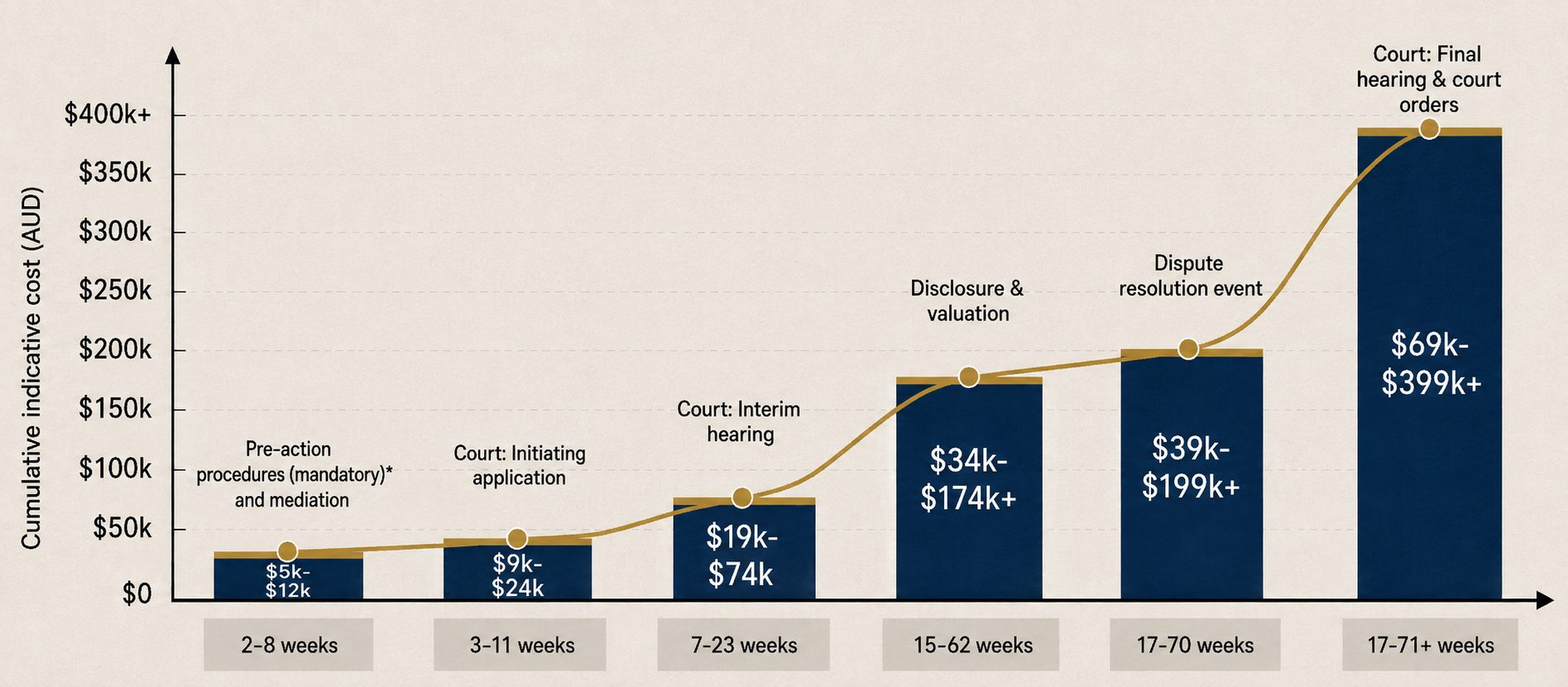
INDICATIVE CUMULATIVE COSTS AND TIME
Family law expenditure varies according to whether the matter resolves by consent, at mediation, after interim applications or only after a final hearing. Parenting risk, business and trust structures, overseas assets, valuation disputes and non-disclosure can increase both complexity and duration.
The cost curves below are planning illustrations rather than quotes and do not include every possible expert, appeal or enforcement step. Regular settlement review and disciplined disclosure can substantially reduce the issues that require judicial determination.
Recovery strategy should be tested against asset availability, security, priority, limitation periods, the administrator’s evidence and the likely net return after legal, expert and insolvency-administration costs.
Family law budgets should be reviewed whenever risk, disclosure, valuations, expert evidence or interim applications change. The commercial and emotional value of each step should be tested against the prospects of settlement and the orders realistically available. Excluding the costs of counsel
Indicative planning ranges only. Figures exclude GST and disbursements unless stated and must be confirmed in a matter-specific written estimate.
Videos, Guides and Articles
INSIGHTS AND PRACTICAL GUIDANCE
Use these resources to understand the procedure, prepare more effectively and identify the questions that should be addressed before the next stage.
The titles and summaries below are editable placeholders for the final published video and article links.
VIDEOS & GUIDES
Voluntary administration, liquidation and receivership
Who controls the company, what happens to claims and how creditor rights differ.
Voluntary administration, liquidation and receivership
Who controls the company, what happens to claims and how creditor rights differ.
ARTICLES

ASSET PROTECTION MOVES INTO THE MARRIAGE? GAMBLING & WASTEFUL SPOUSES.
1. What is the issue?
The issue is whether “addbacks” — assets wasted, spent, or hidden by one spouse —

Court Intervention Held Necessary For General Dysphoria-Related Medical
Keywords: Family Law, Medical Procedures, Childhood gender

Full Court of Family Court Finds No Child Support Resulting Trust Favouring the
What is the Issue?
The case of Bass & Bass and Anor [2016] FamCAFC 64 (29 April 2016) was heard

FOR BEST RESUILTS: BUILD A CLEAR DISPUTE LITIGATION STRATEGY "UPFRONT"
- Urgent risk and asset-protection advice
- Disclosure and valuation planning
- Negotiation, mediation and court representation
Key terms defined
GLOSSARY — FAMILY LAW TERMS
Parenting ordersorders about who a child lives and spends time with, made in the child’s best interests
Property poolall assets, liabilities and superannuation of both parties, however held
Full and frank
disclosurethe ongoing duty to disclose all financial circumstances
Spousal maintenancefinancial support where one party cannot meet reasonable needs
Consent ordersagreed orders approved by the court without a hearing
Family dispute
resolution (FDR)mediation generally required before parenting proceedings (s 60I certificate).
Add Defined Term schema per entry.
Frequently Asked Questions
COMMON QUESTIONS
The Family Law Act changed significantly on 10 June 2025, particularly for property settlements. These answers reflect the current law, including the new treatment of family violence, disclosure and companion animals.
In most parenting matters, yes. You generally need a section 60I certificate from an accredited family dispute resolution practitioner before you can file. Exemptions apply, including urgency, family violence, child abuse, and where a party cannot genuinely participate. Property matters also have pre-action procedure requirements.
Since 10 June 2025 the framework is set out directly in the Family Law Act. The court identifies the assets and liabilities, considers each party’s contributions, considers their current and future circumstances, and then asks whether the proposed division is just and equitable. There is no starting presumption of a 50/50 split.
Yes, this is now written expressly into the Act. Since 10 June 2025 the court must consider the economic effect of family violence when assessing contributions and future circumstances. Financial abuse is specifically recognised, including controlling access to money, building up debt in a partner’s name, and hiding assets.
It is your continuing legal duty to give the other party all relevant financial information and documents, income, assets, liabilities, trusts, company interests, and any disposal of property. Since June 2025 this duty appears in the Family Law Act itself. Hiding assets can lead to costs orders, orders being set aside, and contempt findings.
For married couples, 12 months from the date the divorce becomes final. For de facto couples, two years from the date of separation. After that you need the court’s permission to apply, which is not guaranteed. Separating alone does not start the 12-month clock, the divorce order does.
Since 10 June 2025 the court can make specific orders about companion animals rather than treating them as ordinary property. It considers who cares for the animal, the attachment of each party and any children, any history of cruelty, and whether the animal has been used to threaten or control a partner.
An interim hearing produces temporary orders that apply until the case is finally decided. It is usually short, decided on affidavit evidence rather than oral testimony, and the judge cannot resolve contested facts. Interim orders are not a prediction of the final outcome, but they do set the practical arrangements for months.
Yes, but not easily where final orders already exist. The court will generally only reconsider final parenting orders if there has been a significant change of circumstances and reconsideration is in the child’s best interests. Interim and consent orders are easier to vary, particularly by agreement.
Yes. Urgent injunctions and asset preservation orders are available where there is a real risk that property will be sold, transferred, mortgaged or moved offshore. In genuinely urgent cases these applications can be made without notice to the other party, and speed matters.
The court has strong tools. It can order specific disclosure, issue subpoenas to banks, accountants and employers, draw adverse inferences against the person hiding assets, add back or set aside transactions, and make costs orders. Non-disclosure discovered later can also be a basis to set aside final orders.
Yes, where you can identify a legal or discretionary error, an appeal is not a second chance to re-argue the facts. Appeals generally must be filed within 28 days of the order, and permission is needed for some interim decisions. Get advice on prospects first, because unsuccessful appeals attract costs.
The usual position is that each party pays their own costs. But the court can order otherwise, taking into account the parties’ financial circumstances, whether a party’s conduct or non-disclosure caused wasted costs, whether orders were complied with, and any settlement offers made. Non-disclosure is a common trigger for a costs order.