


CREDITOR RIGHTS, RESTRUCTURING AND TRUST LITIGATION
INSOLVENCY LITIGATION LAWYERS: ASSET PROTECTION, TRUSTS, DEMANDS & LIQUIDATORS.
A plain-English guide to oppression claims, breaches of directors’ duties, company deadlock, and how share buy-outs and winding-up work in Australia.
- Experienced senior lawyers
- Clear pricing guidance
- National practice
UNDERTSANDING INSOVENCY TRUSTEE & LIQUIDATORS COURT DISPUTES
Your Guide
A company is insolvent when it cannot pay debts as and when they fall due. Formal processes include voluntary administration, liquidation, restructuring and receivership, while personal insolvency is governed by bankruptcy law. Each process has strict gateways, priority rules and review rights.
Trust and asset disputes can involve the validity and administration of a trust, trustee duties, access to information, distributions, removal of trustees and claims that trust property should be available to creditors. The facts, governing instrument and statutory context must be analysed together.
Jaswinder Says
In insolvency work, timing and evidence determine leverage: a missed deadline or untested assumption can change the entire recovery position.
— Jaswinder (Jas) Sekhon · Director / Principal
How the INSOLVENCY Process Unfolds
FROM DEFAULT TO REVIEW AND DISTRIBUTION
Insolvency disputes usually begin with default, a demand, an appointment or a disagreement about control of assets or trust property. The appointment of an administrator, liquidator, receiver or trustee changes who controls the process and how claims must be advanced. Creditors often need to lodge proofs, preserve security rights and respond quickly to reports, meetings and proposed distributions.
Clawback, priority and trust claims may require detailed tracing, expert accounting evidence and court directions or substantive proceedings. The pathway below is a high-level guide and must be adapted to the appointment, asset position, security structure and limitation periods.
Default or dispute arises
A payment default, demand, appointment, trustee decision or asset-control issue triggers urgent legal and commercial review.

External administrator appointed
Control may pass to an administrator, liquidator, receiver or bankruptcy trustee, with statutory notices and reporting obligations.

Proofs of debt & claims
Creditors lodge proofs, administrators adjudicate claims and security, priority and trust rights are analysed.

Clawback or trust proceedings
Voidable transaction, insolvent trading, tracing, breach of trust and recovery claims are investigated and commenced where viable.

Priority, distribution or settlement
Competing claims are resolved, distributions are proposed and disputed entitlements may be negotiated or determined.

Review & appeal
Decisions on proofs, remuneration, directions, priority or substantive liability may be reviewed or appealed.
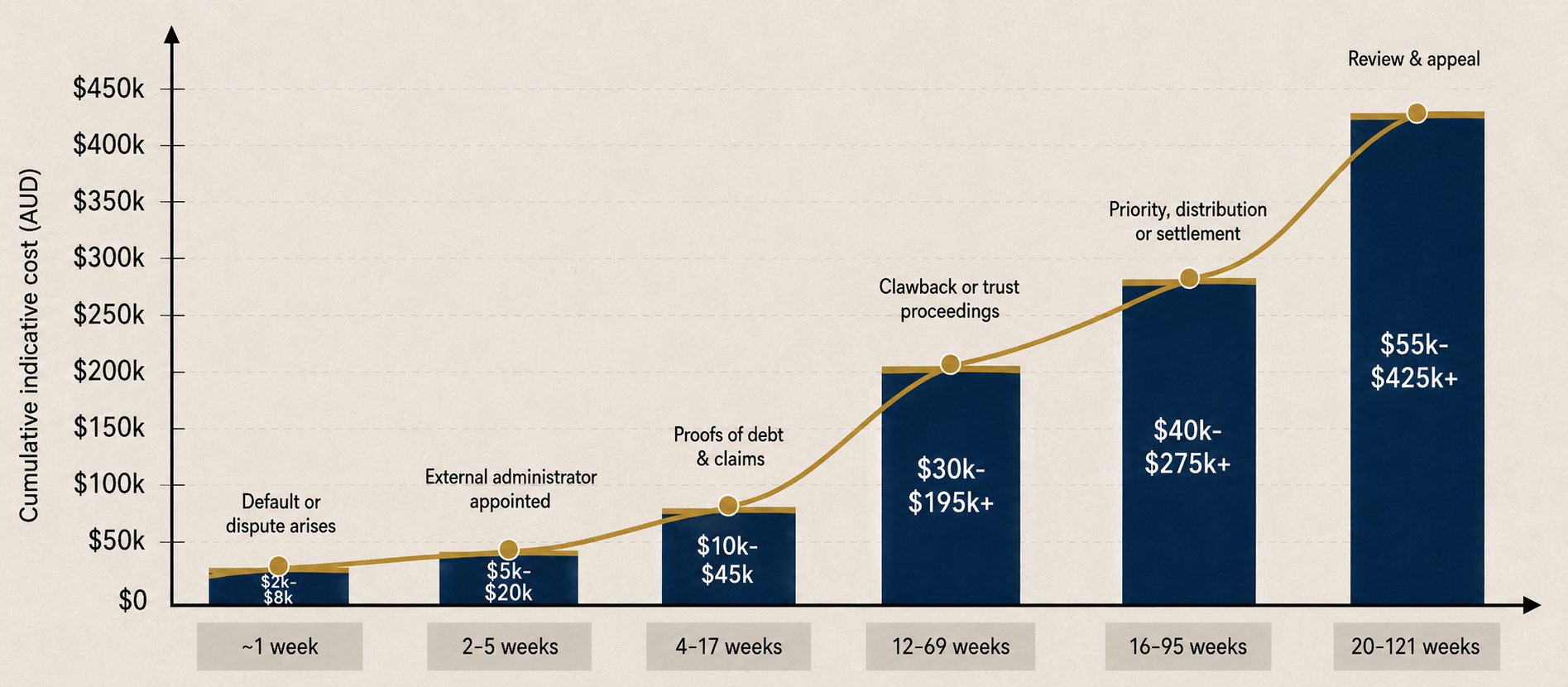
How much does an insolvency dispute cost?
INDICATIVE CUMULATIVE COSTS AND TIME
The cost profile depends on whether the issue is confined to creditor review, requires an administrator’s determination, proceeds to winding-up or involves complex trust and clawback litigation. Forensic accounting, document reconstruction, multiple entities and disputed beneficial ownership can materially increase the work required.
The charts are illustrative and do not replace a written scope or estimate for the particular appointment and recovery strategy. A disciplined merits and recoverability assessment should be completed before significant litigation expenditure is committed.
Recovery strategy should be tested against asset availability, security, priority, limitation periods, the administrator’s evidence and the likely net return after legal, expert and insolvency-administration costs.
Videos, Guides and Articles
INSIGHTS AND PRACTICAL GUIDANCE
Use these resources to understand the procedure, prepare more effectively and identify the questions that should be addressed before the next stage.
VIDEOS & GUIDES
Voluntary administration and liquidation — who controls the company
Who controls the company, what happens to claims and how creditor rights differ.
Statutory demands and trust disputes — the 21-day deadline and trustee claims
Who controls the company, what happens to claims and how creditor rights differ.
ARTICLES

ASSET PROTECTION MOVES INTO THE MARRIAGE? GAMBLING & WASTEFUL SPOUSES.
1. What is the issue?
The issue is whether “addbacks” — assets wasted, spent, or hidden by one spouse —

Court Intervention Held Necessary For General Dysphoria-Related Medical
Keywords: Family Law, Medical Procedures, Childhood gender

Full Court of Family Court Finds No Child Support Resulting Trust Favouring the
What is the Issue?
The case of Bass & Bass and Anor [2016] FamCAFC 64 (29 April 2016) was heard

STRESS TEST YOUR ASSET LOSS "RISKS" BEFORE INSOLVENCY
- Urgent creditor and director advice
- Trust tracing and forensic recovery strategy
- Court, administrator and stakeholder representation
- tatutory demand review and set-aside within the 21-day window
Key terms defined
GLOSSARY — INSOLVENCY & TRUST TERMS
Statutory demand a formal creditor’s demand; 21 days to pay or apply to set aside
Voluntary
administration an insolvency process where an administrator takes control
Liquidation the winding up of a company and distribution of its assets
Voidable transaction /
unfair preference pre-appointment payments a liquidator can claw back
Trustee’s right
of indemnity the trustee’s claim on trust assets for properly incurred liabilities
Breach of trust a trustee acting outside the trust deed or their duties.
Frequently Asked Questions
COMMON QUESTIONS
Insolvency runs on fixed statutory periods, and most of them cannot be extended once missed. These answers cover what happens to a company, what creditors can do, and where trust structures complicate things.
A company is insolvent when it cannot pay all its debts as and when they become due and payable. This is a cash flow test, not just a balance sheet test a company can hold valuable assets and still be insolvent if it cannot pay what is due now.
Voluntary administration is a rescue process. An administrator takes control of the company and investigates it. Creditors then vote on what happens next: end the administration, accept a deed of company arrangement, or wind the company up. Liquidation is the wind-up, assets are sold, claims are checked, and the money is shared out. Administration keeps options open; liquidation closes them.
You complete the prescribed proof of debt form and lodge it with the external administrator, attaching evidence such as invoices, contracts, statements and correspondence. The administrator then adjudicates on it. Poorly evidenced claims are commonly rejected or reduced, so lodge it properly the first time.
Yes. A liquidator can recover unfair preferences, uncommercial transactions, unreasonable director-related transactions and creditor-defeating dispositions where the statutory tests are met. Look-back periods vary, commonly six months for preferences involving unrelated parties, and up to four years or more for related parties. Defences exist, including good faith and running account arguments.
Broadly: secured creditors to the extent of their security, then the liquidator’s costs and remuneration, then priority employee entitlements such as wages, leave and (subject to caps) redundancy, then unsecured creditors sharing rateably. Shareholders rank last and usually receive nothing.
Yes. A court can remove and replace a trustee where the proper administration of the trust requires it, for example conflict of interest, misconduct, incapacity, or a breakdown that leaves the trustee unable to act impartially. The trust deed may also contain a removal power that avoids going to court.
It depends. Where a company acts as trustee the assets belong to the trust, but the trustee’s right of indemnity can be exercised for properly incurred trust liabilities. The answer turns on the trust deed, whether the trustee was validly removed, whether the debts were incurred in the trust’s business, and whether the structure survives challenge.
Yes, wholly or in part. If your claim is rejected you receive written notice, and you generally have a short period, commonly 14 days, to apply to the court to review the decision. These deadlines are strict, so diarise them the day the notice arrives.
Insolvent trading is where a director allows a company to incur a debt while it is already insolvent, or where it becomes insolvent because of that debt, and there were reasonable grounds to suspect insolvency. Directors can be personally liable for the resulting loss. Defences include the safe harbour provisions and reasonable reliance on information.
Very. Statutory demand set-aside applications (21 days), proof of debt reviews, voidable transaction claims and appeals all run on fixed statutory periods, and most cannot be extended once missed. In insolvency, delay almost always costs more than early advice would have.