


COMMERCIAL RESOLUTION WITHOUT UNNECESSARY TRIAL COST
DISPUTE RESOLUTION LAWYERS: MEDIATE, Don't Go TO COURT!
Courts can order parties to mediation even without consent (s 26 Civil Procedure Act 2005 (NSW)), and federal applicants must file a genuine steps statement under the Civil Dispute Resolution Act 2011 (Cth).
- Experienced senior lawyers
- Clear pricing guidance
- National practice
UNDERSTAND MEDIATION & "A.D.R." TO RESOLVE DISPUTES
Your Guide
Jaswinder Says
Preparation converts mediation from a conversation into a decision-making process with evidence, options and authority to settle.
— Jaswinder (Jas) Sekhon · Director / Principal
How the MEDIATION Process Unfolds
FROM AGREEMENT TO ENFORCEABLE RESOLUTION
Mediation can be agreed voluntarily, required by contract, directed by legislation or ordered by a court or tribunal. The quality of the process depends on selecting the right mediator, defining the issues and exchanging focused material before the session.
Parties should attend with decision-makers, realistic settlement parameters and a clear understanding of legal, commercial and non-financial options. Where agreement is reached, the terms must be documented precisely so that obligations, releases, confidentiality and default consequences are clear. The steps below provide a practical sequence for preparing, conducting and implementing an effective mediation.
Agreement or order to mediate
The parties define the dispute, scope, confidentiality arrangements, timing and authority required for the process.
Choose the mediator
Select a mediator with the right subject-matter expertise, style, availability and fee structure.
Exchange position papers
Prepare evidence, chronology, legal analysis, damages and a settlement strategy for the mediator and the other side.

Mediation session
Joint and private sessions test risk, credibility, commercial options and the parties’ best alternatives to settlement.

Terms of settlement
Record payment, performance, releases, confidentiality, costs, default and implementation obligations before the session ends.
Consent orders or enforcement
Convert the agreement into orders where appropriate, complete performance and enforce any default through the agreed mechanism.
MEDIATION & "A.D.R." INDICATIVE COSTS TERMS
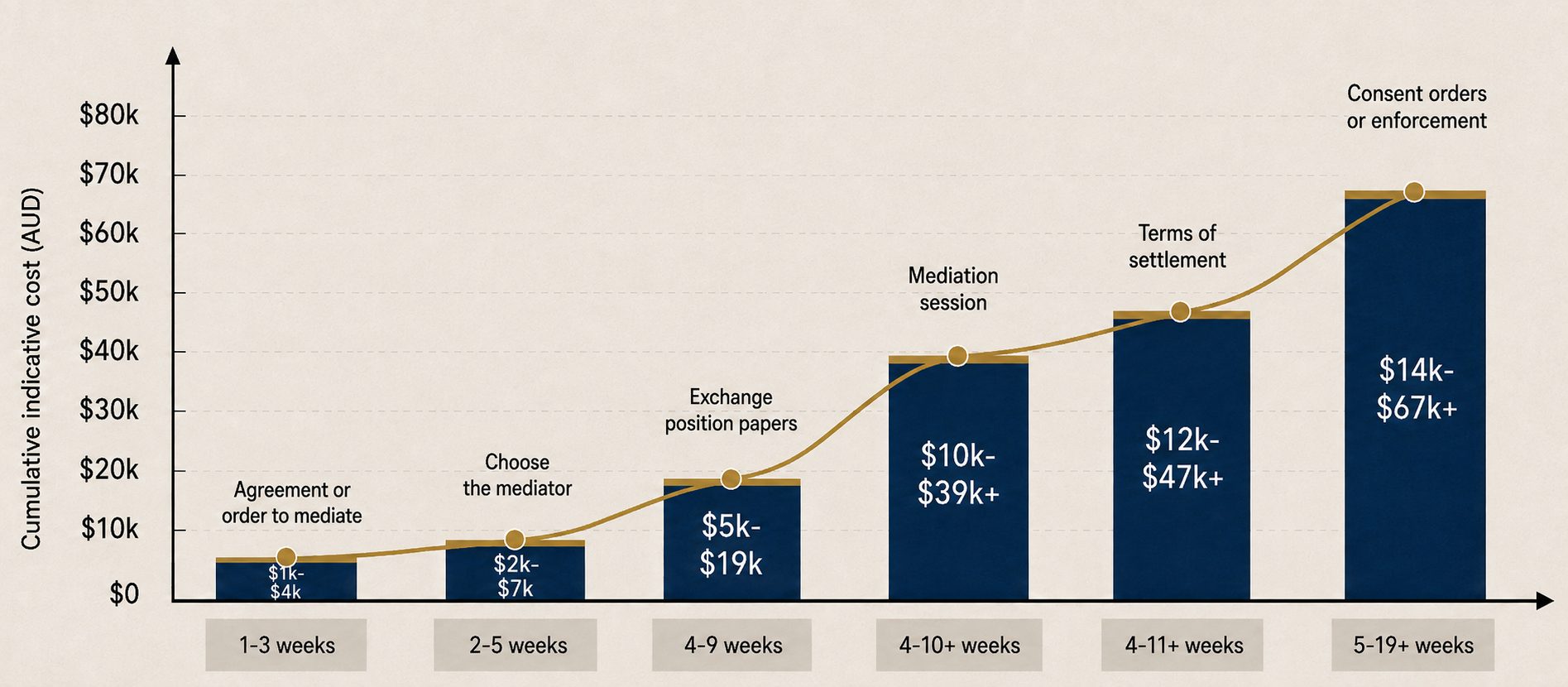
INDICATIVE CUMULATIVE COSTS AND TIME
The charts compare direct negotiation, private mediation, court-ordered mediation and an escalated arbitration or litigation pathway. ADR costs are usually front-loaded into preparation and the session, but can avoid months of interlocutory work and final-hearing expenditure.
The figures are illustrative and vary with mediator seniority, venue, number of parties, complexity, expert involvement and the length of the session. A mediation budget should include the preparation required to make the session useful, not merely the mediator’s fee and the day itself.
The value of mediation should be assessed against the avoided cost, delay, management time and uncertainty of continuing the dispute. A partial settlement or agreed narrowing of issues can also deliver significant value.
Indicative planning ranges only. Figures exclude GST and disbursements unless stated and must be confirmed in a matter-specific written estimate.
Videos, Guides and Articles
INSIGHTS AND PRACTICAL GUIDANCE
Use these resources to understand the procedure, prepare more effectively and identify the questions that should be addressed before the next stage.
VIDEOS & GUIDES
Voluntary administration, liquidation and receivership
Who controls the company, what happens to claims and how creditor rights differ.
Voluntary administration, liquidation and receivership
Who controls the company, what happens to claims and how creditor rights differ.
ARTICLES

ASSET PROTECTION MOVES INTO THE MARRIAGE? GAMBLING & WASTEFUL SPOUSES.
1. What is the issue?
The issue is whether “addbacks” — assets wasted, spent, or hidden by one spouse —

Court Intervention Held Necessary For General Dysphoria-Related Medical
Keywords: Family Law, Medical Procedures, Childhood gender

Full Court of Family Court Finds No Child Support Resulting Trust Favouring the
What is the Issue?
The case of Bass & Bass and Anor [2016] FamCAFC 64 (29 April 2016) was heard

Mediate EARLY TO RESOLVE. SAVE COSTS & TIME.
- Tailored ADR process and mediator selection
- Evidence-led negotiation strategy
- Precise settlement and enforcement drafting
Key terms defined
GLOSSARY - MEDIATION & ADR TERMS
Mediationconfidential, without-prejudice negotiation facilitated by an independent mediator; the parties, not the mediator, decide the outcome
Arbitrationa private process where an arbitrator hears evidence and makes a binding award
Expert determinationan independent expert decides a defined technical or valuation issue, usually finally
Without prejudiceprotection that stops settlement communications being used as evidence in court
Settlement deedthe signed document recording the agreed terms; enforceable as a contract
Court-annexed
mediationmediation ordered or run by the court, which may proceed even without consent.
Frequently Asked Questions
COMMON QUESTIONS
Most disputes settle. Mediation is where that usually happens, and how well it is prepared makes the difference between a settled file and a wasted day. These answers cover the process, cost and confidentiality of mediation.
The mediation itself is not binding, nobody can force you to settle. But if you sign settlement terms at the end, that document is usually a binding contract, and in court-ordered mediations it can be turned into consent orders. Never sign terms you have not read carefully and understood.
Generally yes. Mediation is conducted on a without prejudice basis, and the mediation agreement and legislation protect what is said from being used in court later. There are recognised exceptions, including proving the settlement itself, threats of harm, child safety concerns, and criminal conduct.
Yes. Courts and tribunals across Australia routinely order parties to mediate, with or without their consent, before or after proceedings start. Refusing to participate genuinely can result in an adverse costs order, even if you go on to win the case.
Usually the parties agree. If they cannot, a court, a contractual dispute resolution clause, or an administering body such as the Australian Disputes Centre or a Law Society can nominate one. The choice matters, a mediator with real experience in the subject area is far more likely to break an impasse.
The mediator’s fee and any venue costs are usually shared equally, although the parties can agree otherwise and sometimes one side pays as part of a settlement. Each side pays its own lawyers. Court-annexed mediation, for example before a Registrar, is often free.
The case continues. But mediation is rarely wasted, it narrows the issues, exposes weaknesses in each side’s evidence, and gives both parties a realistic view of their risk. Many disputes settle in the weeks after a mediation rather than on the day itself.
In complex or high-value disputes, usually yes. Counsel can give an on-the-spot assessment of risk, put the case persuasively to the other side, and draft enforceable settlement terms before everyone leaves the room. In smaller matters your solicitor alone may be enough.
The session itself is commonly one day, sometimes half a day, and occasionally spread over several days in complex matters. Preparation usually takes several weeks, collecting documents, exchanging position papers, and getting a realistic valuation of the claim.
Yes, and partial settlement is common and useful. You can resolve specific claims, agree facts, or narrow the issues, then record in writing exactly what remains for the court to decide. That alone can cut hearing time and costs substantially.
Yes, and it is often the best time. Costs are lower, positions are less entrenched, and commercial relationships may still be salvageable. Some areas also require a genuine attempt at resolution before filing, for example family dispute resolution in most parenting matters.