




WORKPLACE RIGHTS, DISMISSALS AND RESTRAINTS
Employee disputes and litigation. Protect your position.
- Experienced senior lawyers
- Clear pricing guidance
- National practice
UNDERSTANDING EMPLOYMENT DISPUTES
Your Guide
An employment dispute is a legal disagreement between an employer and an employee or former employee about dismissal, workplace rights, entitlements or post-employment obligations.
Employment disputes commonly arise from dismissal, employee breach and use of confidential information, adverse action, unpaid wages or entitlements, discrimination, bullying, workplace investigations and post-employment restraints. The correct cause of action and forum matter because the Fair Work Commission, the Federal Circuit and Family Court of Australia and the Federal Court have different powers and procedures.
Dismissal-related applications can carry strict time limits – generally 21 days from the date the dismissal takes effect. Early advice should identify the claim, preserve evidence, assess reinstatement or compensation options and determine whether negotiation, conciliation or litigation best protects the client’s position.
Jaswinder Says
The first strategic decision is not simply whether to protect your business or fight - it is choosing the right claim, forum and remedy before the deadline expires.
— Jaswinder (Jas) Sekhon · Director / Principal
How the Process Unfolds
FROM WORKPLACE EVENT TO RESOLUTION
Employment disputes often move quickly because dismissal applications have short statutory deadlines and early conciliation is common. The process differs according to whether the claim concerns unfair dismissal, general protections, entitlements, discrimination or restraint enforcement.
Evidence such as contracts, policies, emails, warnings, payroll records and decision-making notes should be preserved at the outset. Many matters resolve at conciliation; contested claims may require witness statements, document production, expert evidence or court proceedings. The pathway below is a planning guide and must be adjusted to the remedy sought, the forum and any urgent application.
Dismissal or workplace dispute
Identify the legal issue, preserve documents, calculate entitlements and assess urgent steps such as restraint or injunction advice.

Lodge the application
Choose the correct claim and forum, prepare the application and lodge within the applicable statutory time limit.

Conciliation
The Fair Work Commission or parties explore settlement, reinstatement, compensation, references, confidentiality and release terms.

Evidence & hearing preparation
Prepare witness evidence, submissions, document production and the legal theory required for arbitration or court.
Hearing or negotiated outcome
The matter is determined, settled or converted into enforceable terms dealing with money, employment status and releases.
Remedy, enforcement or appeal
Implement orders or settlement, recover entitlements, enforce restraints or consider appeal and judicial review options.
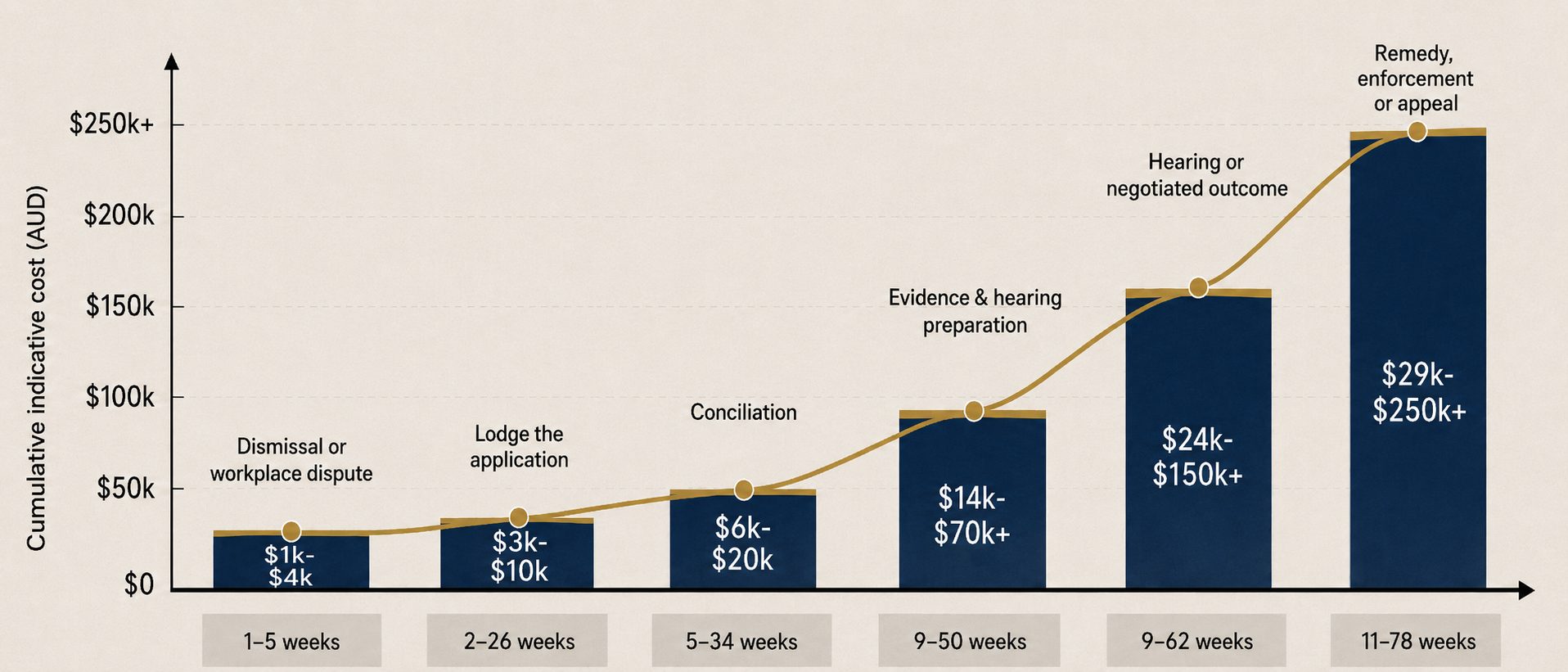
How much does an employment dispute cost?
INDICATIVE CUMULATIVE COSTS AND TIME
The cost pathway depends on whether the matter resolves by direct negotiation, Fair Work Commission conciliation, Commission hearing or federal court litigation. Short limitation periods can compress the first stages, while contested evidence and multi-day hearings can extend the overall timetable.
Costs in the Fair Work Commission are not ordinarily awarded simply because a party wins, whereas court proceedings involve a different costs risk. A staged strategy should compare the value of the remedy with the time, disruption, reputational risk and legal spend required to obtain it.
Employment litigation should be budgeted against the value and type of remedy, the availability of reinstatement, the strength of documentary evidence, witness complexity and whether the dispute remains in the Commission or proceeds to court.
Indicative planning ranges only. Figures exclude GST and disbursements unless stated and must be confirmed in a matter-specific written estimate.
Videos, Guides and Articles
INSIGHTS AND PRACTICAL GUIDANCE
Use these resources to understand the procedure, prepare more effectively and identify the questions that should be addressed before the next stage.
VIDEOS & GUIDES
Voluntary administration, liquidation and receivership
Who controls the company, what happens to claims and how creditor rights differ.
Voluntary administration, liquidation and receivership
Who controls the company, what happens to claims and how creditor rights differ.
ARTICLES

ASSET PROTECTION MOVES INTO THE MARRIAGE? GAMBLING & WASTEFUL SPOUSES.
1. What is the issue?
The issue is whether “addbacks” — assets wasted, spent, or hidden by one spouse —

Court Intervention Held Necessary For General Dysphoria-Related Medical
Keywords: Family Law, Medical Procedures, Childhood gender

Full Court of Family Court Finds No Child Support Resulting Trust Favouring the
What is the Issue?
The case of Bass & Bass and Anor [2016] FamCAFC 64 (29 April 2016) was heard

Protect your business or position before the employment deadline passes.
- Urgent unfair dismissal and general protections filings (21-day limit)
- Restraint-of-trade and confidential-information injunctions
- Fair Work Commission conciliation and hearing representation
Key terms defined
GLOSSARY - EMPLOYMENT LAW TERMS
Unfair dismissalharsh, unjust or unreasonable dismissal under the Fair Work Act 2009 (Cth)
General protections
(adverse action)a stalemate usually between 50/50 owners that stops the company being managed.
Genuine redundancyrole no longer required; consultation/redeployment met
Restraint of tradeenforceable only as reasonably necessary
Constructive
dismissalforced resignation treated as dismissal
Fair Work
Commission (FWC)national workplace tribunal.
Frequently Asked Questions
COMMON QUESTIONS
Employment claims are governed by short, strict deadlines. If you have been dismissed, the single most important thing to know is the 21-day rule. These answers explain the process from lodgement to appeal.
21 days from the day the dismissal takes effect. The same 21-day limit applies to a general protections dismissal application in the Fair Work Commission. The deadline is strict and late applications are only accepted in exceptional circumstances, so act immediately rather than waiting for a final pay slip or separation certificate.
Unfair dismissal asks whether the dismissal was harsh, unjust or unreasonable the focus is on fairness and process. General protections asks why you were treated badly: was it because you exercised a workplace right, made a complaint, have a protected attribute, or took part in union activity? General protections claims have no compensation cap and can cover conduct short of dismissal.
A Commission conciliator runs a confidential telephone conference with both sides, usually within a few weeks of the application. The conciliator does not decide who is right they test each side’s case privately and help you explore a settlement. Most matters resolve at this stage, commonly for a payment and an agreed statement of service.
Usually not. The starting position under the Fair Work Act 2009 (Cth) is that each party pays its own costs, even the winner. Costs are ordered only in limited cases for example where an application was made vexatiously or without reasonable cause, or where it should have been obvious it had no reasonable prospect of success.
Reinstatement is the primary remedy under the Fair Work Act, but it is rarely ordered in practice. Where reinstatement is inappropriate the Commission can award compensation for lost earnings, capped at the lesser of 26 weeks’ pay or half the high income threshold $95,050 for dismissals taking effect in 2026–27. Compensation cannot include an amount for hurt, distress or humiliation.
Sometimes. A restraint is void unless the employer shows it goes no further than is reasonably necessary to protect a legitimate business interest, such as confidential information or client connections. Courts look closely at how long it runs, how wide the geographic area is, and exactly what activities it bans.
Yes, through different pathways. Unpaid wages, leave and other entitlements can be recovered as a small claim in the Federal Circuit and Family Court or a state court, or with help from the Fair Work Ombudsman. Superannuation is enforced by the ATO, and since 1 January 2024 it is also a National Employment Standards entitlement, so underpaid super can be pursued under the Fair Work Act as well.
Keep everything, and do it now. That means your contract, position description, workplace policies, payslips, performance reviews, warnings, emails, text and chat messages, the termination letter, and your own dated notes of meetings. Write down who was present at key conversations while it is still fresh.
Only in exceptional circumstances. The Commission weighs the reason for the delay, when you first knew of the dismissal, any steps you took to dispute it, prejudice to the employer, the merits of the claim, and fairness compared with other employees. Being unwell or waiting for legal advice is usually not enough on its own.
Some decisions can. An appeal to a Full Bench of the Commission requires permission, which is granted only where it is in the public interest and for unfair dismissal you must also show significant error of fact. The deadline is short (generally 21 days). Separate judicial review may be available in the Federal Court.