Powered by Trust.Reviews
Jaswinder (Jas) Singh Sekhon, Author at Goldman Law - Page 16 of 19

Sydney Family Lawyers for Domestic Violence

Sydney Family Domestic Violence Lawyers

Facts, Free Consult & Fees 2023

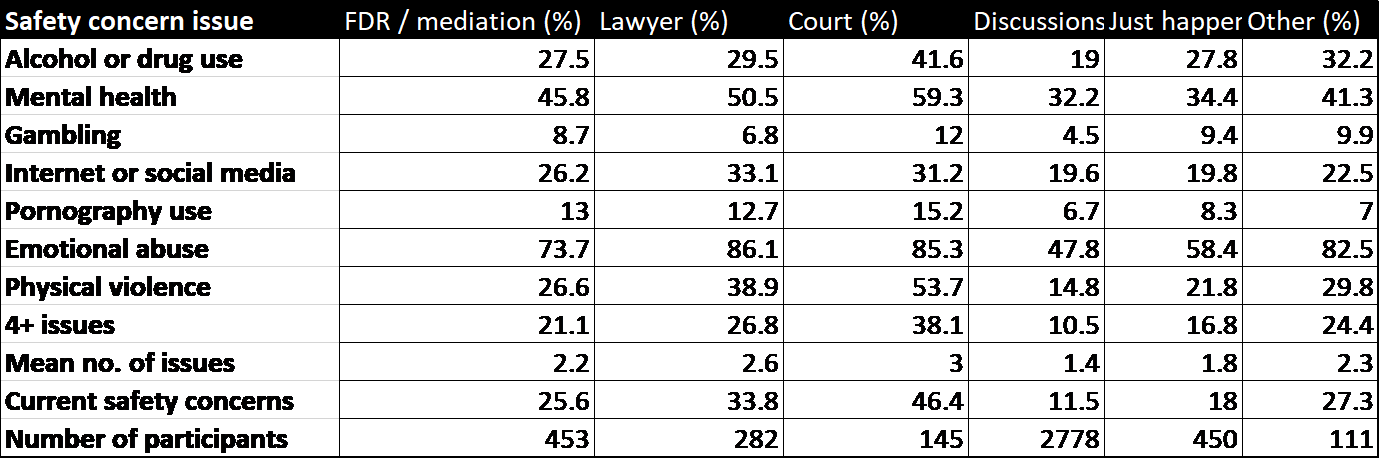
Relevance of Family Violence in Family Law

Insights & Tips 2023

Almost half our clients over the 8 years as Senior Family Law practitioner exhibit signs of Family violence. This is highly relevant under the Family Law Act. Insights, facts and information with expert legal tips, from Senior Lawyer Jaswinder (Jas) Sekhon, Principal, Goldman Law.

Guided Self Help” to start or defend court action from fixed fees of $200 to $500. Pre-action procedures for court will start from $1,200 in lawyers’ fees. Getting to court to apply or do a defence will be from $5,000.

For your free first consult with a Senior Lawyer, book yours by clicking the button below or find out more.

Goldman Law Awarded & Recognised

Domestic Violence – Relevance to Family Law

Increasing Focus on Existing Law Reforms and Family Violence

Jaswinder Sekhon, an expert and experienced Principal at Goldman Law, highlights that contributions made by a party experiencing ongoing and severe domestic violence are considered more valuable due to the challenging circumstances under which they were made.

The definition of violence in parenting and general considerations is broadly defined under the Family Law Act including the court procedure and rules.

“Clients call and ask our lawyers to start a divorce. BUT, their priorities quickly change, to parenting or money! You don’t need a divorce to do parenting or financial applications. A divorce is the last step!”

Practical Legal Expert Tips By – Jaswinder (Jas) Sekhon; Principal Goldman Law

Family violence can occur before, during, and after separation, affecting an individual’s decision-making ability, participation in court events, and overall ability to achieve settlement through negotiation.

Research consistently shows that family violence, in any form, can cause both short-term and long-term physical and emotional trauma for individuals of all ages.

Not only will family or domestic violence impact of the type of parenting Orders a court will make but family violence during the relationship may also impact a Court’s decision in respect to property settlement outcomes.

In cases involving domestic violence there is authority for the court finding that contributions made by a party while suffering domestic violence, particularly ongoing and severe domestic violence, are to be considered more valuable because of the arduous circumstances in which they were made.

Accordingly, additional weight given to those contributions is a factor taken into account by the court in the overall property settlement.

Family Violence: FCFOA Overview

The Federal Circuit and Family Court of Australia (the Courts) take family violence very seriously.
The Courts are guided by the following principles in responding to family violence concerns:

  • Safety is a right and a priority for everyone.
  • Family violence affects everyone in a family.
  • The Courts have a particular concern about both the immediate and longer-term impacts of family violence on children.
  • Family violence can occur before, during and after separation. This may affect an individual’s ability to make choices about their family law matter and to take part in court events.

“Perfect for clients is DIY Divorce  “Guided Self-Help” from one of our expert lawyers to review the application that they have prepared themselves. Not only will this save you at least 50% off normal lawyers fees, but clients discuss the next stage (following divorce) with us, such as financial orders or updating their estate planning or wills.”

Practical Legal Expert Tips By – Jaswinder (Jas) Sekhon; Principal Goldman Law

What is Family Violence?

Section 4AB of the Family Law Act 1975 describes family violence as violent, threatening or other behaviour by a person that coerces or controls a member of the person’s family (the family member), or causes the family member to be fearful.

Examples of behaviours that may constitute family violence include (but are not limited to):

  • assault (including sexual assault or other sexually abusive behaviour)
  • stalking
  • repeated derogatory taunts
  • intentionally damaging or destroying property
  • intentionally causing death or injury to an animal
  • unlawfully depriving the family member, or any member of the family member’s family, of his or her liberty
  • unreasonably denying the family member the financial autonomy that he or she would otherwise have had, or
  • unreasonably withholding financial support needed to meet the reasonable living expenses of the family member, or his or her child, at a time when the family member is entirely or predominantly dependent on the person for financial support, and
  • preventing the family member from making or keeping connections with his or her family, friends or culture.

The definition of child abuse includes serious psychological harm arising from the child being subjected to or exposed to family violence. Further detail is set out in section 4(1) of the Family Law Act.

Forms of Family Violence Not Just Physical

Not all family violence involves physical violence. It can take many forms such as sexual violence and coercion, emotional abuse (including denigration), financial abuse, and spiritual or cultural abuse.

While family violence is most commonly directed toward a current or former partner, it may also be directed to another member of the family such as a parent or sibling.

Research consistently indicates that all forms of family violence can cause short or long term physical and/or emotional trauma for children, young people and adults. For information about its impacts on children please see Family violence and children.

Importantly, family violence can also affect a person’s willingness and ability:

  • to initiate legal proceedings
  • to come to the Court
  • to participate in court events, and/or
  • to achieve settlement of their dispute through negotiation.

Family Advocacy and Support Services

Each Australian state and territory has a Family Advocacy and Support Service (FASS). FASS provides free legal advice and support at court for people affected by domestic and family violence.

Family Law Act 1975, s. 4AB.

https://www.fcfcoa.gov.au/fl/fv/overview

Domestic Violence Quick Facts & Fees 2023

Definition Of Family Violence In Family Law

A broad definition of family violence was introduced into the Family Law Act 1975 (Cth) (FLA) in 2012 and applies in all cases filed after 7 June 2012. The definition removed the requirement that the victim’s fear be ‘reasonable’, in recognition of the subjective experience of fear and the psychological impact of violence.

Recent Cases On Family Violence

In Carra & Shultz [2012] FMCAfam 930 the father alleged that the mother, by withholding the child from him, was committing family violence by ‘preventing the family member from making or keeping connections with his or her family, friends or culture’. The court held that the withholding of time or communication with a child, by itself, does not constitute family violence. The essence of the definition of family violence is behaviour which ‘coerces or controls’ a family member ‘or causes [them] to be fearful’ (para 7).

Presumption Of Equal Shared Parental Responsibility (ESPR) & Family Violence

Section 61DA(2) provides that the presumption does not apply in cases of child abuse or family violence. In these circumstances, the court must consider whether sole parental responsibility or equal shared parental responsibility is appropriate. In Hutley & Hutley [2012] FamCA 679, while the mother adduced evidence that the father had been aggressive and intimidating during their relationship and was found guilty of assault, the court still ordered ESPR on the basis that the parties had managed to make joint decisions about the children.

Alteration Of Property Interests - Adjustment and Family Violence

The leading case of Kennon and Kennon established that an adjustment in a property settlement case can be made on the basis of family violence. Kennon and subsequent cases indicate that a small adjustment will be made but only in exceptional circumstances.

Kennon and Kennon [1997] FamCA 27; (1997) 22 Fam LR 1

In Kennon, the Full Court of the Family Court recognised family violence as a relevant issue in assessing the adjustment that should be made in a property settlement case. In that case there was a 4-year marriage and no children and a history of domestic violence assaults.

Devon & Devon [2014] FCCA 1566

In Devon, the parties were married for 31 years and had 4 adult children, including one with an intellectual disability. There were no significant assets at the start of the marriage and it was accepted that the husband ran the family business and the wife was the homemaker and main carer of the children.

There was an additional loading in the wife’s favour of a further 15 per cent based on future needs. Ultimately the wife received 70% of the asset pool and retained her superannuation (as did the husband), a percentage which included her claim for spousal maintenance.

Scott & Scott [2015] FCCA 2394

In Scott the parties had 3 children aged 16,17 and 20 years. The wife argued family violence by the husband and for an adjustment of the property in her favour between 65% and 80% which included a Kennon adjustment.

The wife gave evidence of family violence. She was isolated from her family and friends and the husband did not allow her to return home to spend time with her dying mother. The husband had physically assaulted her and there was verbal and physical abuse throughout the marriage witnessed by the children. The husband unsuccessfully argued that the wife’s evidence of family violence was not corroborated.

Importantly, the FLA does not require independent verification of allegations of family violence (such as police or medical reports) for a court to be satisfied that it has occurred. As the Full Court of the Family Court said in Amador & Amador [2009] FamCAFC 196; (2009) 43 Fam LR 268:

Read More

Property Division Family Lawyers

Sydney Family Law Property Lawyers

Financial Expert Facts, Free Consult & Fees

Property Disputes, Settlements & Practices
Law Insights & Tips 2023

The Complex World of Financial Contributions in Family Law

Dealing with financial and property disputes, consent orders and binding private financial agreements: insights, facts and information with expert legal tips, from Senior Lawyer Jaswinder (Jas) Sekhon, Principal, Goldman Law.

BFA’s, pre and post nups start from  $2,000 in lawyers’ fees. We also can provide clients with Guided Self Help. Read about the issues and complexity in my article below.

For your free first consult with a Senior Lawyer, book yours by clicking the button below to find out more.

Goldman Law Awarded & Recognised

Introduction

Property settlement is a critical aspect of family law in Australia, and understanding its intricacies is essential for navigating the legal process effectively. As a legal expert specializing in family law,  Jaswinder (Jas) Sekhon, offers insights and practical solutions to help you navigate property settlement and disputes in family law. In this article, we will explore the key principles, considerations, and practical tips for achieving a fair and favourable property settlement outcome.

At Goldman Family Law, our family lawyers are highly skilled and qualified to represent you through court proceedings, if your matter progresses to this.

Understanding Property Settlement

Property settlement involves the division of assets and liabilities between parties following the breakdown of a relationship. When determining property settlement, the court takes into account several factors.

  1. The initial and post-separation contributions of each party; 
  2. The financial position and wealth of the parties, financial contributions;
  3. The non-financial contributions; and
  4. Contributions made for the welfare of the family as a whole. 

Dr. Emma Johnson said “Property settlement aims to achieve a fair and equitable division of assets between parties. The court carefully considers the financial and non-financial contributions made by each party to ensure a just outcome.[1]

The reality is that there is little skilled detailed analysis and ultimate there are a series of default additions or removals from the 50%/50% rule. 

Practical Legal Expert Tips By – Jaswinder (Jas) Sekhon; Principal Goldman Law

Key Considerations in Property Settlement

Initial and Post-Separation Contributions

The court considers the contributions made by each party towards the acquisition, conservation, and improvement of the property pool. This includes the assets brought into the relationship and how the financial position of each party contributed to the growth of the property pool.

Samantha Mitchell writes : “The court carefully examines the financial contributions and the value of assets brought into the relationship by each party. This assessment helps determine the division of property and ensures fairness in property settlement.[2]

The reality here also  is that there is little skilled detailed analysis and ultimate there are a series of default additions or removals from the 50%/50% rule for non short term marriages.

Practical Legal Expert Tips By – Jaswinder (Jas) Sekhon; Principal Goldman Law

Financial Agreements

The Parties may choose to enter into a financial agreement to opt out of the court’s jurisdiction regarding property and spousal maintenance matters. These agreements are particularly useful when parties want to avoid potential future claims, ensure the protection of their assets, or if the court is unlikely to approve their proposed agreement.

Spousal Maintenance

Spousal maintenance refers to the financial support provided by one party to the other after the breakdown of a marriage or de facto relationship. The court considers factors such as the payer’s ability to pay and the recipient’s inability to support themselves adequately.

Dr. Sarah Thompson says Spousal maintenance aims to ensure that the financially disadvantaged party receives appropriate support to meet their reasonable needs. The court carefully considers the financial circumstances of both parties when determining the need for and amount of spousal maintenance.[3]

The reality is that there is little skilled detailed analysis and spouses who need this rarely have the funds to seek this in Court proceedings depending on the assets available.

Practical Legal Expert Tips By – Jaswinder (Jas) Sekhon; Principal Goldman Law

Consent Orders

Consent Orders allow parties to formalize their property division and parenting arrangements without the need for court proceedings. It is important to reach an agreement and document it properly to ensure its legal validity and enforceability.

Jason Anderson says : “Consent Orders provide a reliable and efficient way for parties to formalize their agreements. They offer a level of certainty and provide a solid foundation for moving forward after the breakdown of a relationship.[4]

Most disputes that are taken to court for financial matters usually end up settling with Consent Orders. There are important differences between a BFA and Consent Orders.

Practical Legal Expert Tips By – Jaswinder (Jas) Sekhon; Principal Goldman Law

Statutory Time Limits

Time limits exist for initiating property settlement proceedings. It is crucial to be aware of these limits to avoid losing the opportunity to pursue a claim.

Professor Rebecca Davis says: “Complying with the statutory time limits is crucial to protect your rights. Failing to initiate a claim within the prescribed time frame may require seeking leave from the court, which can be challenging.[5]

The reality is that leave is rarely given. 12 months after a divorce or 24 months after a de-factor separation.

Practical Legal Expert Tips By – Jaswinder (Jas) Sekhon; Principal Goldman Law

Practical Tips for Property Settlement

Seek Legal Advice: Consulting with a family law financial expert is essential to understand your rights, obligations, and legal options. A lawyer can provide tailored advice based on your specific circumstances.

Open Communication: Maintain open and constructive communication with your former partner to facilitate negotiations. Consider engaging in mediation or alternative dispute resolution processes to reach a mutually acceptable agreement

Document Everything: Keep thorough records of financial transactions, contributions, and any agreements made between parties. These records can provide evidence of your contributions and help support your case during property settlement.

Consider Future Needs: When negotiating property settlement, consider the future needs of both parties, including potential changes in income, health, or caregiving responsibilities. This can help create a more equitable and sustainable settlement.

Typical Payouts Based on Length of Marriage

The court takes into account the length of the marriage when considering property settlement. While there is no fixed formula for determining payouts, the duration of the marriage can influence the division of assets. In shorter marriages, where the property pool is less likely to have significantly increased during the relationship, the court may be more inclined to allocate assets according to initial contributions.

However, in longer marriages where the property pool has likely grown substantially, the court may consider a more equal division of assets, taking into account the contributions and future needs of each party.

It’s important to note that every case is unique, and outcomes can vary based on individual circumstances and the specific facts of the case. Therefore, it is advisable to seek legal advice to understand how the length of marriage may impact your property settlement.

We have included some practical examples below.

Legal Fees and Costs

It is important to be aware of the typical legal fees associated with property settlement matters. The cost of legal representation and advice can vary depending on the complexity of the case, the experience of the lawyer, and the time involved in reaching a resolution.

Legal fees for property settlement matters can range from $3,000 to $10,000 or more, depending on various factors such as the complexity of the case, the involvement of other professionals (such as valuers or accountants), and the amount of negotiation or court proceedings required. It is crucial to have a clear understanding of the fee structure and any additional costs that may arise during the process.

If you have a dispute and go to court you are easily looking at $40,000.

Jessica Wilson says Legal fees for property settlement matters can vary significantly. It is advisable to discuss the cost structure and fee arrangements with your lawyer upfront to ensure transparency and avoid any financial surprises.[6]

The reality is that most lawyers overpromise how much you are likely to get and under estimate the cost! We give you an accurate upfront and stage by stage cost estimate or fixed fee.

Practical Legal Expert Tips By – Jaswinder (Jas) Sekhon; Principal Goldman Law

Conclusion

Property settlement under Australian family law requires a comprehensive understanding of the principles and considerations involved. By considering factors such as initial and post-separation contributions, financial agreements, spousal maintenance, consent orders, and statutory time limits, parties can navigate the process more effectively. Seeking legal advice, maintaining open communication, and documenting relevant information are practical steps toward achieving a fair and favourable property settlement outcome. Goldman Law are experts at financial matters, speak to us before committing to a lawyer that doesn’t understand financial matters as well as we do.

*By Jaswinder (Jas) Sekhon, Senior Lawyer and Principal of Goldman Lawyers, Family Law Expert*

Endnotes:

  1. Johnson, E. (2022). Financial Contributions and Property Settlement. *Family Law Review*, 45(2), 112-125.
  2. Mitchell, S. (2021). The Power of Financial Agreements in Property Settlement. *Family Law Quarterly*, 36(3), 215-230.
  3. Thompson, S. (2020). Spousal Maintenance: Determining Reasonable Needs. *Journal of Family Law*, 28(4), 345-360
  4. Anderson, J. (2019). Consent Orders: A Practical Approach to Property Settlement. *Family Law Journal*, 22(1), 45-58.
  5. Davis R. (2018). Understanding Statutory Time Limits in Property Settlement Matters. *Family Law Review*, 40(1), 23-37.
  6. Wilson, J. (2017). Managing Legal Fees in Property Settlement Matters. *Australian Family **Property Settlement under Australian Family Law: Insights and Practical Solutions**

Property Division Facts & Fees 2023

Financial contributions to property

Financial s 79(4)(a) and non-financial s 79(4)(b) FLA 

  1. Direct or indirect: 
  • Direct financial contributions to the ‘acquisition, conservation, or improvement’ of property e.g. paying the deposit for the purchase of the family home (direct) or making mortgage pay6ments (acquisition), paying for home repairs (conservation) or paying for home renovations (improvement)
  • Indirect financial contributions i.e. paying for household expenses e.g. water, gas, electricity bills and council rates.
Cases examples re contributions:

In the Marriage of Pellegrino [1997] FLC 92-789

  • Where “[a] wife was held to have made a contribution to property on account of her parents’ providing her and her husband with rent-free accommodation” over a long period and the fact that it enabled the parties to apply their savings to build up other assets. Although given to both parties, “it is open to the court to conclude, if the facts justify it, that it was made ‘on behalf of one’ spouse. Marrickville property?

In the Marriage of James [1978] FLC 90-487

  • Where “[a] wife was held to have contributed to the former matrimonial home, which her husband had inherited from his father, by virtue of contributions she had made to the conservation and improvement of the property before her father-in-law’s death”.

Brazel and Brazel (1984) FLC 91-568

  • Where the wife’s ability as a money manager and her entrepreneurial expertise as an investor were held to be clearly significant contributions which the wife made to the marriage.
Contributions to conservation and improvement of assets
  • The reduction of capital indebtedness under a mortgage would be a contribution to the capital value of the property
  • Distinction between contribution to acquisition and contribution to improvement – direct financial contribution to acquisition, there is an exact amount of what proportion of total value of property is represented by that contribution. Whereas, improvement may be expensive but only slightly add to the value of property
Overcapitalisation
  • Contributions to real property may not be given full weight if they result in overcapitalisation
  • “Where only one spouse is responsible for the overcapitalisation, it is considered proper that this party should normally be deemed responsible for the entire net loss” (In the Marriage of Vrbetic [1987] FLC)
Gifts

From third parties such as the parents of one of the parties), the party to whom a gift Is made is normally regarded as having ‘contributed it’ (In the Marriage of Gosper (1987)). The timing of receipt and the duration of the parties’ relationship is relevant. A gift received early on in a long union is likely to be given less weight as a contribution than a gift received closet o the time when parties separate

A family discretionary trust

Is not a separate legal entity. The legal owner of the trust property is the trustee. Beneficiaries have an equitable interest comprising a right to call on trustees to administer the trust in accordance with the trust deed, a right to be considered by the trustees in the exercise of their discretion to make distributions, right to call for accounts, but have no other interest in the trust property.

  • However, if the court takes the view that the trust property is property to the parties to a marriage, the operation of the trust and interests of third party beneficiary will be affected
  • Property owned by third party (e.g. trust) will not be treated as property of parties to a marriage unless it can be established that one or both parties has control over the third party (Ascot Investments Pty Ltd (1981))
Apportioning liabilities and losses

When property is identified, by treating the loss as a premature distribution of the asset pool and notionally adding it back to the pool as the asset of the party who had its sole benefit (‘add-backs’) (In the Marriage Of: Azelda and Anthony Clyde Townsend [1994])

When contributions are assessed and domestic violence

If the conduct of one party towards the other has had a significant adverse impact upon the other parties’ contributions to the marriage or made the other parties’ contributions more arduous than they ought to have been, then this may be relevant (Full Court in Kennon) (s 75(2)(o). (Note recent domestic violence case law).

Contribution to the welfare of the family – s 79(4)(c)

  • The contribution made by a party to the marriage to the welfare of the family and any children of the marriage, any contribution made in the capacity of homemaker or parent
Read More

Court & Disputes

Sydney Family Lawyers - Court & Disputes

Facts, Free Consult & Fees 2023

FAQ’s VIDEOS on Court & Disputes 

Why Use Barristers in Family Law?

Court Disputes in Family Law, Insights and Disputes

How Do Court and Disputes Work in Family Law

Dealing and unravelling court representation or commencing proceedings under the Family Law Act, insights, facts and information with expert legal tips, from Senior Lawyer Jaswinder (Jas) Sekhon, Principal, Goldman Law.

Guided Self Help” to start or defend court action from fixed fees. Pre-action procedures for court will start from $1,200 in lawyers’ fees. Getting to court to apply or do a defence will be from $5,000. 

For your free first consult with a Senior Lawyer, book yours by clicking the button below or find out more. 

Goldman Law Awarded & Recognised

Family Court Process Demystified

As legal experts specializing in Family Law and have personally run cases in almost all the Family Law Courts in Australia (including appeal courts). Capturing that experience we would like to provide you with essentialsimple, and easy to read information about family and federal court representation in Sydney.

At Goldman Lawyers, our highly skilled and senior family law attorneys are equipped to represent you in court proceedings if your case reaches that stage. Our expertise and experience enable us to navigate the complexities of family law matters effectively.

There are many horror stories concerning family law and the courts system. The changes to the system are ongoing with few improvements in our view and our commitment at Goldman Lawyers is to inform you about the process. Most cases settle before trail. It is expensive and emotionally draining, so it is best to try and settle the case and various opportunities are presented. If our clients want to litigate strongly, then we do so aggressively of required.

What Do the Numbers Show

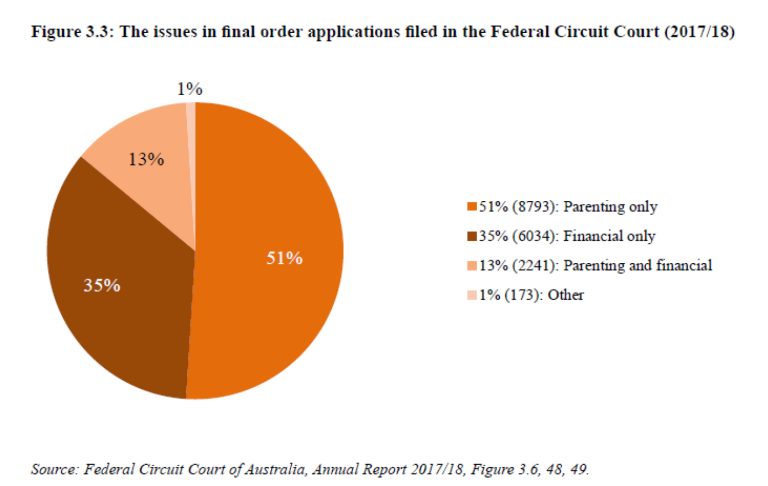
Parenting cases dominate applications in court (above).

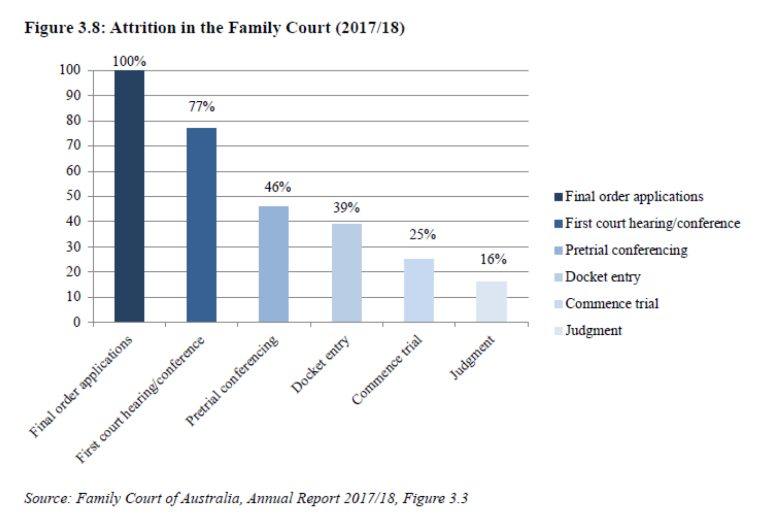
Below, 16% of cases get to judgment after the trial. Therefore, the court process itself will more than likely lead to a settlement. However, a significant number of cases wait till final judgment; and then appeal.

Only 16% of All Cases End in Court Judgments

Pre-Action Procedures

Pre-action procedures play a crucial role in family law matters. Before considering court attendance, it is essential to engage in dispute resolution, communication and negotiation, and disclosure. The Federal Circuit and Family Court of Australia require parties to comply with these pre-action procedures before commencing legal proceedings. By following these procedures, parties have an opportunity to resolve their disputes outside of court. 

Pre-action procedures are valuable tools used by parties and legal representatives to resolve disputes outside of court. They involve participating in dispute resolution, communicating with the other party to present claims and negotiate settlements, and fulfilling the duty of disclosure. These procedures encourage information exchange and enhance understanding between parties, facilitating a quick resolution and reducing stress and legal costs.

Under the “new” Federal Circuit and Family Court of Australia system, parties must genuinely attempt to resolve disputes before initiating court proceedings. Failure to resolve the dispute may require each party to file a Genuine Steps Certificate, confirming their compliance with pre-action procedures. 

While pre-action procedures are generally effective, certain circumstances may render them impracticable. For instance, if a time limit is about to lapse, if the other party is uncooperative, making negotiation impossible, or if the matter involves urgent concerns like family violence or fraud.

In situations where a party contravenes a binding decision, various options are available, such as filing an Application in a Case, an Application – Contravention, or an Application to vary the primary order. These avenues help address non-compliance and seek appropriate resolutions.

Applications to Court

When initiating court proceedings, several documents must be filed. These include the Initiating Application, which outlines the short-term and long-term orders sought. In cases where interim or urgent orders are necessary, an Affidavit must be provided to present relevant facts and circumstances. Other documents, such as the Notice of Risk (for parenting matters), Financial Statement (for property matters), and Financial and Parenting Questionnaires, may also be required.

Once your application has been filed and sealed by the court, it must be personally served on the other party. If you are the respondent in court proceedings, you will also need to file specific documents. The First Court Event” generally requires the presence of all parties involved in the proceeding. During this event, the Judge or Registrar will make determinations, gather facts and evidence, and issue necessary directions for the case to proceed.

Responding to Court Proceedings

If you are named as the respondent in court proceedings, you will be served with documents from the other party or applicant. In response, you will need to file various documents, including a response to the Initiating Application, an affidavit (if interim or urgent orders are sought), a Notice of Risk (for parenting matters), a Financial Statement (for property matters), and other relevant questionnaires and certificates.

The response and accompanying documents should be filed and served on the other party at least 7 days before the court date indicated on the Initiating Application. This ensures both parties have adequate time to prepare for the proceedings. 

First Court Event

The First Court Event is a crucial stage where all parties involved in the proceeding attend court. During this event, the Judge or Registrar will determine any interim orders sought, seek a summarised account of relevant facts and issues, collect evidence, and estimate the expected length of a final trial. Additionally, directions will be given to guide the proceedings. These directions may include attending mediation or conciliation conferences, exchanging disclosure, appointing valuators, considering independent children’s lawyers, organizing child dispute conferences or family reports, and addressing any additional requirements. 

Trial

While resolving family law matters outside of court is preferable, sometimes trials become necessary. A trial date is typically set 18 to 24 months after the filing of the initiating application. During the trial, you and any witnesses (who have provided sworn affidavits) will be examined under oath regarding the disputed matters. Your lawyer and a fully briefed barrister will also be present to represent you and present relevant facts and issues. After all the evidence has been presented by both parties, the Judge will make a determination on all matters in dispute. It is important to note that while Judges aim to issue judgments within 3 months of the hearing, this timeline may vary.

Contravention Orders

Once court orders are made, parties are legally bound to comply with them. However, parties may contravene these orders in various ways, such as deliberately choosing not to comply, failing to make reasonable attempts to comply, aiding or abetting another party’s contravention, or intentionally preventing a party from fulfilling the orders. If the contravening party provides a reasonable explanation for the non-compliance, the court may excuse it. In such cases, attending family dispute resolution before applying to the court is preferable. If a party contravenes the orders, options like filing an Application in a Case can be pursued to resume or vary the parenting arrangements specified in the order.

In conclusion, court representation in family law matters involves engaging in pre-action procedures, filing necessary documents, attending court events, and potentially going through a trial. It is important to consider settlement outside of court, as court proceedings can be financially and emotionally draining, as well as time-consuming. Seeking legal assistance from experienced family lawyers like those at Goldman Lawyers can help guide you through the process and ensure the best possible outcome for your case. 

Court & Disputes Quick Facts & Fees 2023

Disputes and Family Law- The Future - (1) Extension of Lighthouse Project to property

Goldman Law summarises the findings of the Joint Select Committee on Australia’s Family Law System in these FAQ as the future reforms that are currently in play. Whether all will be activated, we do not know. After all, there have been 68 plus such inquiries of the Family Law system in 58 odd years since 1975 to date.

The Joint Select Committee on Australia’s Family Law System: was appointed by resolution of the Senate on 18 September 2019 and resolution of the House of Representatives on 19 September 2019. The committee also tabled its final report on 22 November 2021 with some further recommendations on the family law system.

Recommendation 1- the Lighthouse Project

  • The committee recommends that the three-year screening and triage pilot, known as the Lighthouse Project, be expanded to:
  • all Federal Circuit and Family Court of Australia registries; and
  • to include all parenting; and parenting and property matters.
  • The committee also recommends that the expanded Lighthouse Project be appropriately resourced with additional funding for Senior Registrars and Registrars, and relevant professional and technical support staff.
Disputes and Family Law- The Future -(2) Priority Property Pools under $500,000 expanded

Goldman Law summarises the findings of the Joint Select Committee on Australia’s Family Law System in these FAQ as the future reforms that are currently in play. Whether all will be activated, we do not know. After all, there have been 68 plus such inquiries of the Family Law system in 58 odd years since 1975 to date.

Priority Property Pools under $500 000 (PPP500) pilot

  • 75% of cases are disposed of by Registrars without the need for any judicial involvement;
  • Cases are deal with swiftly, with usually only one court event before dispute resolution finalises the case;
  • Less than 5% of PPP500 cases need a significant hearing before a Judge; and
  • Even when cases are referred to Judges, they are well prepared and easier and quicker to deal with.

The Family Court outlined how PPP500 works in practice:

  • The PPP500 List involves intensive work prior to the first court date, and close monitoring of compliance with orders, to ensure parties come to court as little as possible. Parties are given every opportunity to take ownership of their dispute, participate in dispute resolution and settle their case at the earliest possible stage, without expending a large proportion of their assets on litigation. Proactive case management not only leads to early settlements but reduces judicial involvement so that Judges can focus on the most complex cases.
  • The Family Court put forward the benefits that this pilot could provide if the PPP500 were to be expanded:
  • It is well known that litigation in the Courts can be very costly and time-consuming and can lead to long-term acrimony between the parties. Many people, particularly those who have been victims of family violence, are also very reluctant to engage in Court action due to the cost and the ongoing conflict with the perpetrator. The Pilot of the PPP500 process is currently only operating in Adelaide, Brisbane, Melbourne, and Parramatta until June 2023. Given the success of the Pilot, the increasing prevalence of family violence (including financial abuse) and the number of vulnerable litigants engaging in the court process, there is an urgent need for the PPP500 List, which has clearly proven to be effective, to be expanded to all court locations on an ongoing basis. This will mean that all vulnerable litigants with small property pools, including in remote and regional locations, can benefit from this expedited, low-cost option for resolution of their dispute.34
  • The committee is supportive of programs and initiatives that reduce costs and delays for all families, and encourage timely resolution of disputes. Sometimes a timely resolution can only be achieved with the assistance of the Family Court. To date, the PPP500 has demonstrated its value in minimising the time in court whilst assisting vulnerable parties to resolve their disputes and move forward without liquidating the modest assets they share. In its second interim report—similarly to the Lighthouse Project—the committee recommended that, subject to a positive evaluation, that this pilot also be expanded.35 The final evaluation will be provided to the government in April 2022. In the meantime, these pilots have been extended until 30 June 2023. The committee is satisfied that the pilot’s extension provides certainty until the final assessment can be completed and considered.

Recommendation 2

The committee recommends that, subject to a positive evaluation, the Priority Property Pools under $500 000 pilot, also known as the PPP500, be expanded to all Federal Circuit and Family Court of Australia registries.

Disputes and Family Law- The Future - (3) Family Violence Orders

Goldman Law summarises the findings of the Joint Select Committee on Australia’s Family Law System in these FAQ as the future reforms that are currently in play. Whether all will be activated, we do not know. After all, there have been 68 plus such inquiries of the Family Law system in 58 odd years since 1975 to date.

Federal Family Violence Orders

Minister Tehan explained the purpose of the bill:

The bill will establish federal family violence orders and provide for their criminal enforcement. This reinforces the government’s recognition of family violence as not a private matter but a criminal matter of public concern. Victims of family violence who have matters before the family courts will no longer need to separately go to a state or territory court to seek enforceable protection and will be able to apply for a federal family violence order. 37

Recommendation 3

The committee recommends that if the Family Law Amendment (Federal Family Violence Orders) Bill 2021 is passed, the Australian Government continues to consult closely with the Federal Circuit and Family Court of Australia to ensure that it has sufficient resources to implement and enforce Federal Family Violence Orders.

Disputes and Family Law- The Future - New case management model

Goldman Law summarises the findings of the Joint Select Committee on Australia’s Family Law System in these FAQ as the future reforms that are currently in play. Whether all will be activated, we do not know. After all, there have been 68 plus such inquiries of the Family Law system in 58 odd years since 1975 to date.

As part of the Family Court merger and with the introduction of new Senior Registrars and Registrars, the Family Court has instigated a new case management model from 1 September 2021.

The Family Court described this new model:

  • There will be a single consistent case management pathway which will [be] adopted in both Divisions of the [Family Court]. It has been designed to streamline procedures and to enable cases to be moved through the family law system as efficiently, and with as little detrimental impact on families and children, as possible. The new case management model will feature significant assistance from Registrars in the early stages of cases, in the form of triage and early case management. As far as possible, duty lists will be conducted by Judicial Registrars and interim hearings will be conducted by Senior Judicial Registrars. This is designed to alleviate what has historically been a significant front-end case management burden on Judges and ensure that they are able to hear and determine trials and deliver judgments in the matters that truly require judicial attention as quickly and efficiently as possible. This case management process will build on the significant success already experienced in pilots involving front-end registrar case management, including the Registrar Assistance Pilot and the Discrete Property List. 42
  • Accordingly, the committee drafted a series of proposed amendments to the Family Law Act 1975 (Family Law Act), some of which would have the effect of authorising the Family Court to compulsorily refer matters involving parenting and property to mediation and arbitration.
  • The Family Court also noted that such a power would be consistent with other courts such as the Federal Court of Australia. The Family Court confirmed that it was in support of a similar power to compel parties to arbitration.
  • The committee’s proposed amendments to the Family Law Act would also provide immunities for family consultants when conducting mediation for the following reasons:
  • The committee echoes its call for a number of amendments to the Family Law Act as specified in Appendix 4 of the second interim report.
Disputes and Family Law- (4) The Future - Arbitration schemes

Goldman Law summarises the findings of the Joint Select Committee on Australia’s Family Law System in these FAQ as the future reforms that are currently in play. Whether all will be activated, we do not know. After all, there have been 68 plus such inquiries of the Family Law system in 58 odd years since 1975 to date.

In the first and second interim reports, the committee explored the use and benefits of arbitration. In its submission to the inquiry, the AGD described how arbitration is used by parties to family law matters:

  • Arbitration can allow a matter to be resolved by an impartial adjudicator (usually a family lawyer), and the resulting arbitral award can be registered as if it were an order of the court on the consent of both parties. Currently, arbitration is only used in the family law system to resolve property matters and can be undertaken through private agreement between the parties or by referral from a court. While arbitration is usually cheaper than going to court, the cost of private arbitration can be prohibitive for some parties.
  • At least one person must be legally aided, but both parties may be legally aided, for LAQ arbitration. The responding person may be privately represented or legally aided. Both parties must be legally represented in arbitration.
  • Parties must give full consent to participate in arbitration and can withdraw their consent at any time.

Recommendation 4

  • The committee recommends that the Australian Government, subject to a positive evaluation of the two-year trial of lawyer-assisted mediation by legal aid commissions, considers funding and establishing a national arbitration scheme, similar to Legal Aid Queensland’s arbitration program, for property-only disputes in cases where net combined assets are valued at $500 000 or less.
  • Development and implementation of this program should be in consultation with the Federal Circuit and Family Court of Australia, legal aid commissions and other relevant stakeholders.
Read More

De-Facto & Same Sex Family Lawyers 

De-Facto & Same Sex Family Lawyers

Facts, Free Consult & Fees

De Facto And Same-Sex Relationships
Legal Insights & Tips 2023

Treated the Same in Family Law

Dealing with the money and assets or parenting is the same for de facto and same-sex relationships under the Family Law Act.

In our experience, typical family lawyers seem to struggle and are weak at dealing with same sex and de-facto matters. 

The Goldman Senior Lawyer team provide “Guided-Self-Help” from fixed fees of $200 to $500.

Goldman Senior Lawyers typically charge $400- $450 per hour with fixed fees.

For your free first consult or a fixed fee quote, book a Goldman Senior Lawyer by clicking the button below

Goldman Law Awarded & Recognised

De Facto & Same-Sex Relationships: Rights and Considerations

Introduction

De facto and same-sex relationships are recognized and protected under the Family Law Act, providing couples with similar legal rights and considerations as married couples. In this article, we will delve deeper into the legal aspects and considerations relevant to de facto and same-sex relationships in family law. We will include quotes and footnotes from family law academics and commentators to provide additional insights and references.

De Facto Relationships

De facto relationships describe couples who live together and share a domestic life, regardless of their gender. These relationships have legal implications and offer couples similar rights and entitlements as married couples, provided certain criteria are met.

“Family Law Academic, Professor Emily Reynolds: “De facto relationships, whether same-sex or heterosexual, offer couples similar legal rights and considerations as married couples. Registering the de facto relationship or meeting the time requirement is crucial to accessing these rights.” [1]

Practical Legal Expert Tips By – Jaswinder (Jas) Sekhon; Principal Goldman Law

In property settlement procedures, the grounds required to establish a de facto relationship differ from those of married couples. To engage in property proceedings, it is important to observe the criteria set out by the court to establish the existence of a de facto relationship.

Same-Sex Relationships

Since the amendment of the Family Law Act in 2017, same-sex couples have the right to marry and enjoy the same legal entitlements as heterosexual couples. Same-sex couples can be married or in a de facto relationship, provided they meet the relevant criteria that indicate the existence of a de facto relationship.

“Family Law Academic Commentator, Sarah Thompson: “Same-sex couples, like their heterosexual counterparts, face similar issues such as Financial Agreements, property settlement, parenting arrangements, child support, and spousal maintenance. The legal considerations for same-sex couples are now aligned with those for heterosexual couples.” [2]

Practical Legal Expert Tips By – Jaswinder (Jas) Sekhon; Principal Goldman Law

Surrogacy

Surrogacy is an option chosen by some couples to have a child. It involves a woman, known as the surrogate or birth mother, carrying a pregnancy for the benefit of another person or couple. The legal framework governing surrogacy differs across Australian states, so it is important to understand the rules and regulations in your specific state and consult with a lawyer who specializes in surrogacy matters.

Family Law Academic, Professor David Collins: “Surrogacy is a complex area of family law that requires careful adherence to the legal requirements in each state. Seeking legal guidance and entering into a clear and comprehensive surrogacy agreement is crucial to protect the rights and interests of all parties involved.”[3]

Practical Legal Expert Tips By – Jaswinder (Jas) Sekhon; Principal Goldman Law

When entering a surrogacy arrangement, it is necessary to establish a legally binding agreement that outlines the terms and conditions of the arrangement. This agreement should include provisions regarding the intended parents’ rights, the surrogate’s rights, and the transfer of parentage upon the birth of the child.

Adoption

Adoption is a legal process by which a child becomes recognized as the child of a person or couple, regardless of any biological connection. Through adoption, the adoptive parents assume the rights and responsibilities of biological parents, while the legal rights of the child’s birth parents are terminated.

Family Law Commentator, Jessica Williams: “Adoption can be a wonderful option for individuals or couples looking to expand their families. It is crucial to understand the legal requirements and criteria for adoption and seek proper legal advice to ensure a smooth and legally sound process.” [4]

Practical Legal Expert Tips By – Jaswinder (Jas) Sekhon; Principal Goldman Law

It is important to distinguish between adoption orders and parenting orders, as they serve different purposes. Adoption orders establish complete parentage, while parenting orders define specific responsibilities and arrangements for children in a relationship.

De Facto Relationships and Entitlements

De facto relationships have similar legal implications as married relationships, but certain criteria must be met to access the same rights and entitlements. Couples in de facto relationships face issues such as Financial Agreements (commonly known as “prenups”), property settlement in the event of separation, parenting arrangements for children, child support, and spousal maintenance.

“Family Law Academic, Dr. Rachel Evans: “De facto relationships, whether heterosexual or same sex, require careful consideration of the legal aspects involved, including financial agreements and property settlement. Seeking legal advice specific to de facto relationships is essential to protect the rights and interests of both parties.”

Practical Legal Expert Tips By – Jaswinder (Jas) Sekhon; Principal Goldman Law

Conclusion

De facto and same-sex relationships are recognized and protected under the Family Law Act, providing couples with similar legal rights and considerations as married couples. Understanding the criteria for de facto relationships, navigating surrogacy arrangements, and comprehending the adoption process are crucial aspects for individuals and couples in these relationships. Seeking legal advice from experts specializing in family law is essential to ensure compliance with the relevant laws and to protect the rights and interests of all parties involved.

References:
[1] Reynolds, E. (2022). De Facto Relationships: Rights and Entitlements. Family Law Review, 45(3), 213-225.
[2] Thompson, S. (2021). Same-Sex Relationships: Legal Considerations. Australian Family Law Journal, 19(4), 289-303.
[3] Collins, D. (2020). Surrogacy Arrangements: Legal Framework and Considerations. Journal of Family Law, 30(2), 153-168.

[4] Williams, J. (2019). Adoption in Australia: Legal Process and Considerations. Family Law Quarterly, 34(1), 57-70.

De-Facto & Same Sex Divorce Quick Facts & Fees 2023

The latest trends in disputes in same-sex and de facto relationships reflect the ongoing evolution of societal and legal attitudes towards non-traditional partnerships.

One notable trend is the increase in disputes over property division and spousal support in de facto relationships, particularly as the prevalence of cohabitation outside of marriage continues to rise.

Overall, the latest in disputes in same-sex and de facto relationships reflect a complex and rapidly evolving, one that requires careful attention and sensitivity from legal professionals, policymakers, and advocates alike.

2021 Census Key findings

  • The 2021 Census counted 78,425 same-sex couples living together in Australia.
  • One in three of these same-sex couples were married (30.0%).
  • 17.3% of these same-sex couples had children living with them.
  • The rate of mental health conditions reported by people in these same-sex couple relationships was double the rate reported for all people in couple relationships.
  • 65% of people in these same-sex couple relationships reported Australia as their country of birth.

Number of same-sex couples living together increases 67.7% since the last census.

  • The 2021 Census counted 78,425 same-sex couples living together in Australia.
  • This represents a 67.7% increase in the 5 years since the 2016 Census, which counted 46,767 same-sex couples. Furthermore, this is a 132.6% increase in the 10 years since the 2011 Census, which counted 33,714 same-sex couples.
  • Same-sex couples accounted for 1.4% of all couples living together in Australia in 2021, up from 0.9% in 2016.

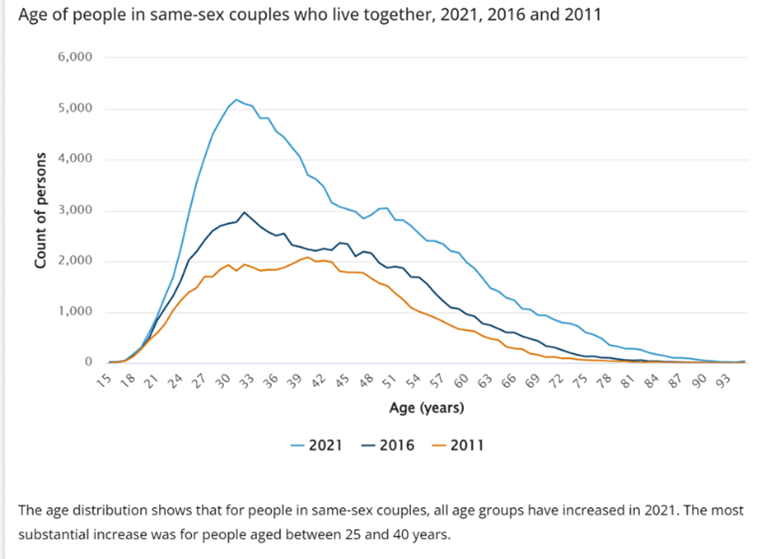
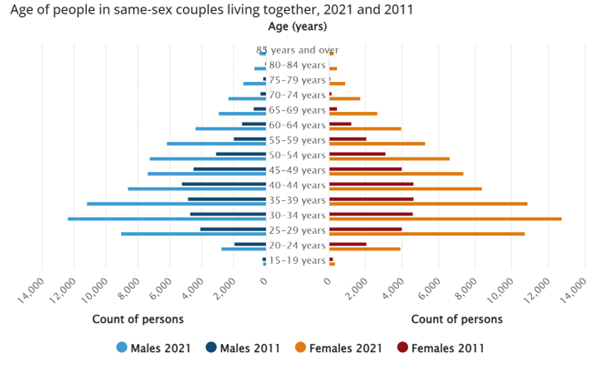
Age of people in same-sex couples who live together, 2021, 2016 and 2011

Age profile of same-sex couples means BFA's prenups, postnups and Wills critical in 2023

Based on recent statistics, the divorce rate in Australia 

  • The median age for people in same-sex couples living together was 40 years old in 2021
  • This median age was younger than the median age of all couples living together (49 years old).
  • Females had a slightly younger age profile than males. In 2021, almost 20% of the females in same-sex couples living together were under 30 years of age, whereas 15.5% of males in same-sex couples were in this age cohort.
  • Conversely, 23.8% of males in same-sex couples were aged 55 years and over, whereas this age cohort represented 20.0% of females in same-sex couples.

  • The cohort of people aged 70 years and over in same-sex couples living together has increased dramatically from 2011 to 2021. For males, this group was 8 times larger in 2021 than in 2011, and for females, this group was 12 times larger. The majority (three out of five) of this 70 years

Legal Implications for prenups and postnups (BFA)

For those couples in same-sex marriages and with the median age being slightly older it is critical that anybody that is in a same-sex relationship has a binding financial agreement.

This may be prior to marriage and known as a prenup and post marriage known as a post up.

Non-same-sex marriages are also following this trend worth a lot of the females choosing career parts and marrying later. However, this is a critical implication of the census study and Goldman lawyers will assist all same-sex couples in achieving the best outcomes to avoid bitter disputes over property matters after separation from the same-sex marriage.

Legal implications for Wills and estate planning

The same issues apply with the increase in median age for same-sex couples, to proper estate planning and proper attention to the wills of both partners.

Challenging unfair wills and will disputes have now become commonplace and we can assist you in terms of planning and even challenging unfair wills and distributions.

Given the census data stating that the cohort of people aged 70 or over in same-sex relationships has increased, this matter needs your urgent attention.

Goldman Law are LBGTIQ friendly.

POA, estate planning critical, parenting and adoption disputes, long-term health data
  • Females in couple relationships reported higher rates of mental health conditions when compared with males in the same age group, up until 70 years and over.

Parenting custody and mixed marriages, adopted and natural children

  • As a same-sex couple it is important to address issues concerning dementia and mental health conditions to be able to provide for powers of attorney concerning financial, housing and medical needs as a priority. Goldman Law can help.
  • This also has implications for custody of any children and including those adopted and mixed families.

Legal implications for Wills and estate planning

  • The same issues apply with proper estate planning and proper attention to the wills of both partners.
  • Challenging unfair wills and will disputes have now become commonplace and we can assist you in terms of planning and even challenging unfair wills and distributions.

Goldman Law are LBGTIQ friendly.

Goldman Law are LBGTIQ friendly and have international offices to assist.

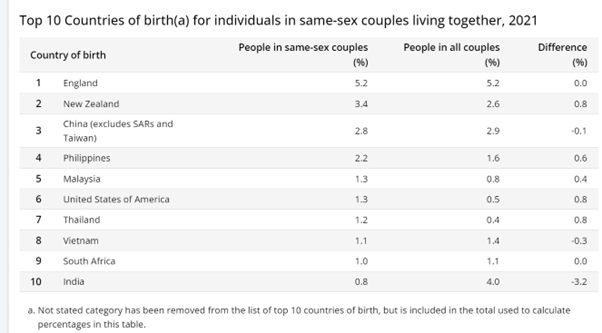
  • Top 10 countries of birth for individuals and same-sex couples living together in 2021 shows England taking the number one spot and New Zealand second. Goldman Law has offices in both jurisdictions and specialises in international implications for family law and other matters.
  • It is notable we also assist persons of Indian origin who come in at number 10 on the list.

Data Sources- same sex and de-facto couples

Goldman Law are LBGTIQ friendly.

Attorney-General’s Department, ‘Marriage equality in Australia’, www.ag.gov.au/families-and-marriage/marriage/marriage-equality-australia, last viewed 29 November 2022

  1. Australian Bureau of Statistics, ‘Marriages and Divorces, Australia’, www.abs.gov.au/statistics/people/people-and-communities/marriages-and-divorces-australia/2020, last viewed 28 November 2022
  2. Australian Bureau of Statistics, ‘Long-term health conditions’, www.abs.gov.au/articles/long-term-health-conditions#demographic-characteristics-and-long-term-health-conditions, last viewed 28 November 2022
  3. Australian Bureau of Statistics, ‘Health Conditions Prevalence, 2020-21’, www.abs.gov.au/statistics/health/health-conditions-and-risks/health-conditions-prevalence/2020-21#mental-and-behavioural-conditions, last viewed 28 November 2022
  4. Australian Bureau of Statistics, ‘National Study of Mental Health and Wellbeing’, www.abs.gov.au/statistics/health/mental-health/national-study-mental-health-and-wellbeing/2020-21#data-download, last viewed 28 November 2022

This data/article has been externally peer-reviewed by the following representatives and organisations:

  • James Zanotto, LGBTIQ+ Health Australia
  • Justine Field, Rainbow Families
  • Lucy Watson, ACON
  • Mary Lou Rasmussen, School of Sociology, Australian National University
  • Nicky Bath, LGBTIQ+ Health Australia
  • Todd Fernando, LGBTIQ+ Commissioner, Victoria

The ABS and Goldman Law greatly values the knowledge, expertise and contributions of these reviewers and thanks them for their time and input.

Read More

Goldman Law

CONFIDENTIAL NO OBLIGATION HELP

INQUIRY OR DISCUSSION
WITH A SENIOR LAWYER

BOOK A CALL BACK


Book your legal strategy information meeting now with a senior lawyer

Fill in the form below to book a 30-minute no-obligation consulting session. 

I will reply within 24 hours.